Toshiba Adds Four Quad-Channel Digital Isolators at 25 Mbps and 0.2 mA per Channel
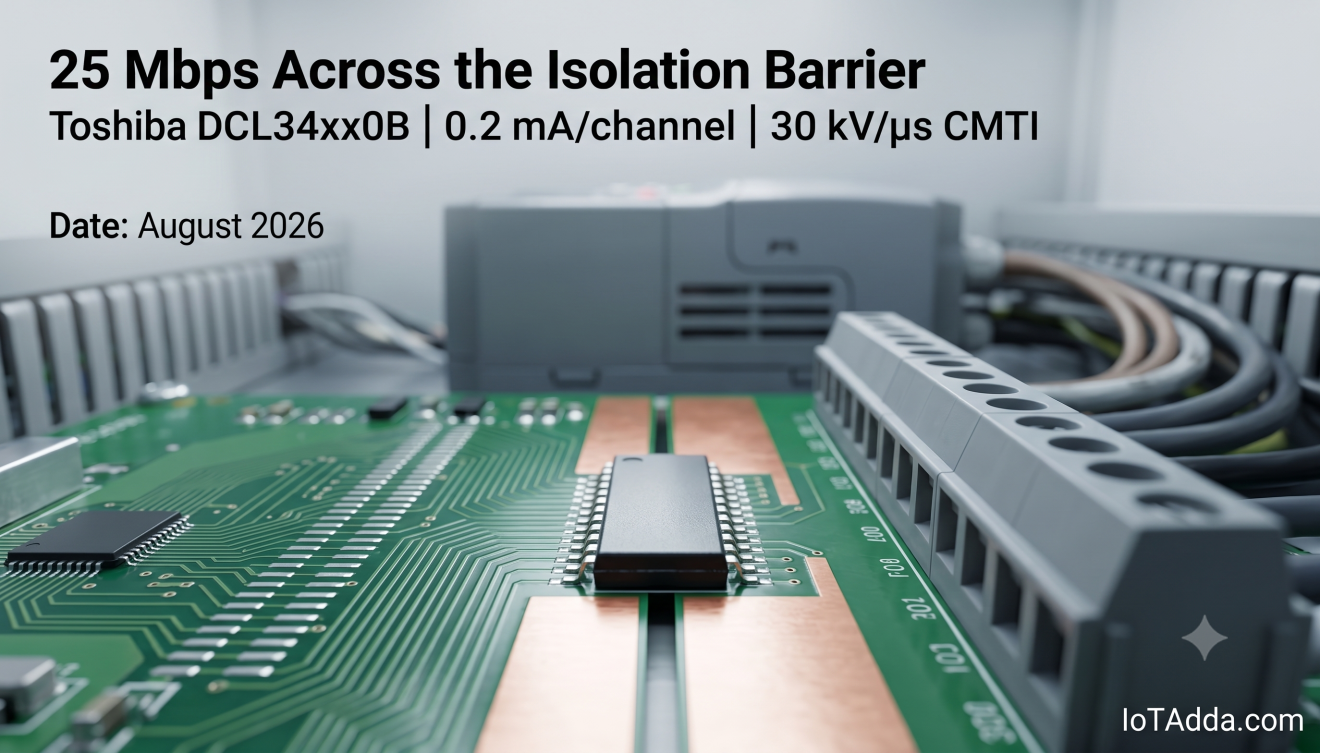
Toshiba has expanded its DCL34xx0B series with four quad-channel digital isolators aimed at industrial automation, quoting typical current consumption of 0.2 mA per channel at data rates up to 25 Mbps.
The four parts split into two channel configurations: the DCL340L0B and DCL340H0B carry four channels all in the same direction, while the DCL342L0B and DCL342H0B provide a two-in, two-out arrangement.
Specifications
| Parameter | DCL34xx0B series |
| Channels | 4 (4:0 or 2:2 configurations) |
| Data rate | Up to 25 Mbps |
| Current consumption | 0.2 mA per channel, typical |
| Supply voltage | 2.25 V to 5.5 V |
| Isolation voltage | 3,000 Vrms minimum |
| Common-mode transient immunity | 30 kV/µs minimum |
| Package | SSOP16 |
| Temperature range | −40 °C to +125 °C |
Toshiba lists the target applications as programmable logic controllers, I/O interfaces, sensors and actuators, motor drives, inverters and switching power supplies. Propagation delay figures, pricing and availability dates were not published with the announcement.
The two numbers that decide the design
Two specifications on that list do most of the work in a real design, and neither is the headline data rate.
The first is 0.2 mA per channel. Isolation is rarely a single-channel problem — a PLC I/O card might isolate sixteen or thirty-two channels, and isolator supply current is drawn from the isolated side, which is typically fed by a small transformer or a DC-DC converter sized as tightly as the design allows. Multiply a milliamp of carelessness by thirty-two channels and the isolated supply has to grow. Multiply 0.2 mA and it does not.
The second is 30 kV/µs of common-mode transient immunity. This is the specification that determines whether the isolator keeps working when it is sitting next to a motor drive. When an IGBT or SiC device switches, the voltage on one side of the isolation barrier moves relative to the other extremely fast, and an isolator with insufficient CMTI will produce spurious output transitions — data corruption with no obvious cause, appearing only when the motor runs. Anyone who has debugged an industrial board that behaves perfectly on the bench and erratically in a panel has met this failure.
Why the 2:2 variant is the interesting one
The bidirectional part deserves more attention than it will get. A great deal of industrial communication is half-duplex over a shared pair — RS-485 running Modbus RTU being the obvious example, and still the workhorse of Indian factory floors and energy-metering installations. Such an interface needs isolation in both directions: the driver and receiver lines, plus a direction-control signal.
With a 4:0 device you often end up fitting a second package to get the return path, paying for eight channels to use five. A 2:2 part covers a typical isolated RS-485 interface in one package, which saves board area, one set of decoupling capacitors and a line on the bill of materials. On a dense I/O card where every square millimetre near the terminal blocks is contested, that is a more useful improvement than another five megabits of speed almost nobody will use.
Toshiba has not said when the parts reach distribution or what they cost, which are the two things a designer needs before committing. Until those appear, this is a specification worth noting rather than a part worth designing in.
Related articles
- A $2,000 Desktop AI Box Is Going After Nvidia’s $6,950 DGX Spark — and the TOPS Argument Is the Interesting Part22 October 2026
- SEMICON India 2026 Opens Today With 600+ Exhibitors — and One Scorecard Worth Watching18 September 2026
- PM Modi to Inaugurate SEMICON India 2026 on 17 September, With 500+ Exhibitors From 40 Countries28 August 2026
- The Semiconductor Market Hit $368 Billion in One Quarter — Memory Is Why28 August 2026
- Espressif’s $2 ESP32-C61-MINI Puts Wi-Fi 6 and Bluetooth 5.3 Into a 13 mm Module26 August 2026