Espressif’s $2 ESP32-C61-MINI Puts Wi-Fi 6 and Bluetooth 5.3 Into a 13 mm Module
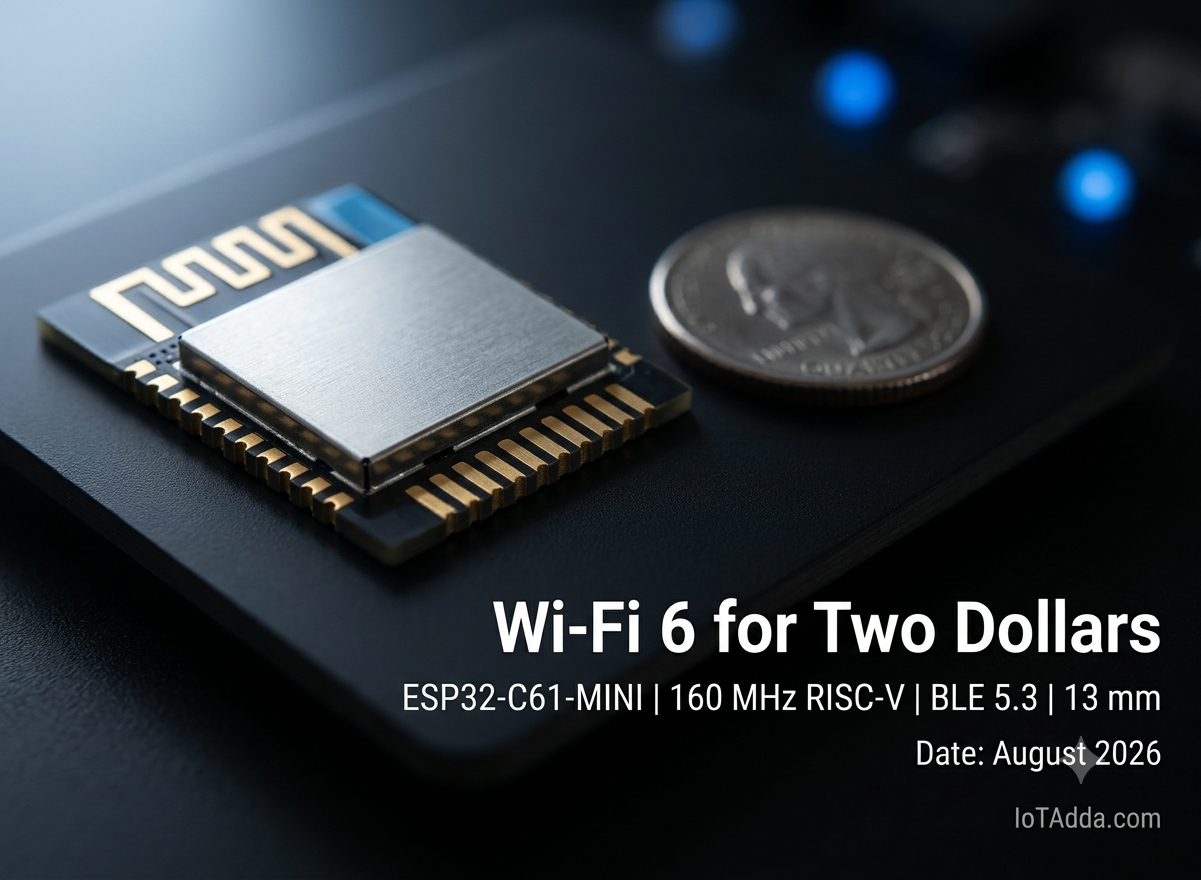
Two variants are now on general sale at roughly two dollars each — a 160 MHz RISC-V core, 53 GPIO pads, target wake time and BLE mesh. The interesting specification is not the speed.
Espressif’s ESP32-C61-MINI-1 and ESP32-C61-MINI-1U modules are now available at around $2 per unit, or $10.70 for a pack of five. For that, a designer gets Wi-Fi 6, Bluetooth LE 5.3 and a RISC-V core in a package measuring 13.2 × 16.6 × 2.4 mm.
The two variants differ only in how they radiate: the MINI-1 carries an onboard PCB antenna, the MINI-1U brings out an external antenna connector for designs that need the aerial somewhere other than the board.
What is inside
| Parameter | ESP32-C61-MINI-1 / 1U |
| CPU | Single-core 32-bit RISC-V, up to 160 MHz |
| Memory | 320 KB SRAM, 256 KB ROM, optional 8 MB PSRAM, up to 8 MB quad SPI flash |
| Wi-Fi | 802.11ax (Wi-Fi 6), 1T1R, 20 MHz-only in non-AP mode, MCS0–MCS9, target wake time; backward compatible with 802.11b/g/n |
| Bluetooth | Bluetooth LE 5.3, mesh support, high power mode to 20 dBm |
| I/O | 53 GPIO pads — SPI, UART, I2C, I2S, USB, JTAG |
| Supply | 3.0 V to 3.6 V |
| Temperature | −40 °C to +85 °C |
| Dimensions | 13.2 × 16.6 × 2.4 mm (MINI-1) |
On the software side, ESP-IDF v6.0 supports the part natively. Arduino support requires building the libraries yourself, and CircuitPython is at alpha firmware — worth knowing before committing a project timeline to it.
Why target wake time is the specification that matters
It is tempting to read “Wi-Fi 6” as a throughput claim and move on. On a part like this it is not. The radio is 1T1R and operates 20 MHz-only in non-AP mode — Espressif has deliberately declined the bandwidth features of the standard.
What it kept is target wake time. TWT lets a device negotiate a specific schedule with the access point for when it will wake to transmit and receive, rather than waking to listen for beacons on the network’s terms. For a battery-powered sensor, that is a direct reduction in radio-on time, and it is the single most useful thing Wi-Fi 6 offers a low-power device.
The second benefit is density. Wi-Fi 6’s scheduling — OFDMA and improved handling of many simultaneous clients — was designed for congested environments. A hundred nodes in a factory or a building is exactly the situation where classic Wi-Fi degrades badly, and where an ostensibly slower Wi-Fi 6 node behaves better than a faster Wi-Fi 4 one.
What a $2 module changes
For Indian product teams, the number to sit with is not the clock speed but the BOM line. At roughly $2 in small quantities from a retail channel, the wireless module stops being the component that decides whether a product can be connected at all.
That threshold matters more here than in most markets. A large share of Indian connected-product work is price-anchored against an unconnected incumbent — a water pump controller, an energy sub-meter, a cold-storage monitor that a customer will buy for a specific figure or not at all. When connectivity costs a meaningful fraction of the bill of materials, it gets argued out of the design in the second cost review. When it costs two dollars, that argument stops happening, and the discussion moves to where it should be: whether the product needs a cloud at all, who pays for the backhaul, and who supports the thing for five years.
One caveat worth holding onto. Cheap silicon does not make cheap products — certification, antenna tuning, firmware update infrastructure and field support are where connected-hardware budgets actually go, and none of those got cheaper this month. What changed is that the excuse for shipping an unconnected product got weaker.
Related articles
- STMicroelectronics Unveils STM32H5 Discovery Kit for Secure, Smart, and Connected Devices20 September 2023
- Moving Faster with Bluetooth 5.08 June 2017
- Development kit to build wireless demos without coding expertise3 June 2017
- Cypress introduces new Energy Harvesting Evaluation Kit on Mouser2 June 2017
- New IoT Dev Kit for Smart Cloud-Based Apps with Mouser2 June 2017