The Semiconductor Market Hit $368 Billion in One Quarter — Memory Is Why
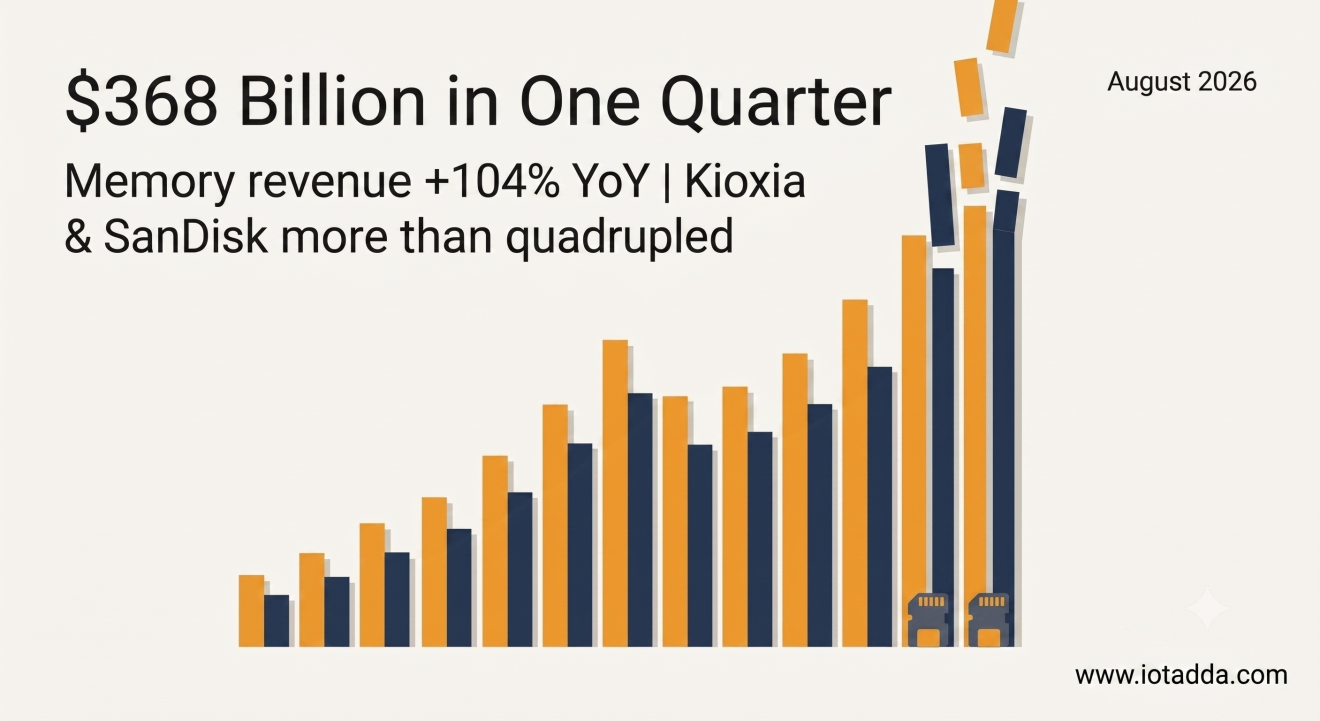
The global semiconductor market reached $368 billion in the second quarter of 2026, up 104% year on year and 35% quarter on quarter. The growth was not spread evenly across the industry — it was concentrated almost entirely in memory, and within memory, in the companies making NAND flash and DRAM for AI infrastructure.
The numbers behind the headline
SK Hynix and SanDisk both grew revenue 51% quarter on quarter. Kioxia grew 76% quarter on quarter. Kioxia and SanDisk both more than quadrupled their revenue compared with the same quarter a year earlier — not a cyclical uptick, a step change. Forecasts for the full 2026 calendar year now put memory-sector growth at 249–280%.
This is the same underlying dynamic we wrote about yesterday when covering NAND flash pricing directly: AI infrastructure demand has pulled semiconductor manufacturing capacity toward high-bandwidth memory for GPU accelerators, and that reallocation is squeezing supply of conventional DRAM and NAND. What’s new here is the scale, expressed in the memory makers’ own reported revenue rather than in downstream pricing — and it confirms the pricing story wasn’t a one-quarter blip. It’s a sustained reallocation of the entire memory industry’s manufacturing capacity.
Why this matters beyond the memory makers themselves
A semiconductor market growing 104% year on year sounds like unambiguously good news for the industry, and for memory makers’ shareholders, it is. For anyone buying memory rather than selling it, the read is closer to the opposite: this level of revenue growth for memory suppliers is only possible because pricing power has shifted decisively toward them. Every design with a meaningful flash or DRAM line item in its bill of materials is on the paying end of exactly the number this article is celebrating.
The forecast of 249–280% growth for the full year is the detail worth sitting with longest. That is not a forecast of things stabilising. It is a forecast of this getting more pronounced before it gets calmer — which means a BOM re-quote done this month is not a one-time fix. It is the first of what should be a repeated exercise through at least the rest of this year.
Related articles
- India’s Hiring Game Is Changing: Recruiters Hiring For Skills Over Degrees12 June 2025
- Europe’s $20 Billion AI Bet: Gigafactories, GPUs, and the Race for Global Relevance27 May 2025
- Jony Ive and OpenAI Team Up to Design the Future of AI Hardware22 May 2025
- Max Transtech’s Digital Transformation: Redefining Logistics with IoT and AI16 December 2024
- Tata Electronics Appoints Bobby Mitra as CIO and President of AI & Digital Transformation11 October 2024