A $2,000 Desktop AI Box Is Going After Nvidia’s $6,950 DGX Spark — and the TOPS Argument Is the Interesting Part
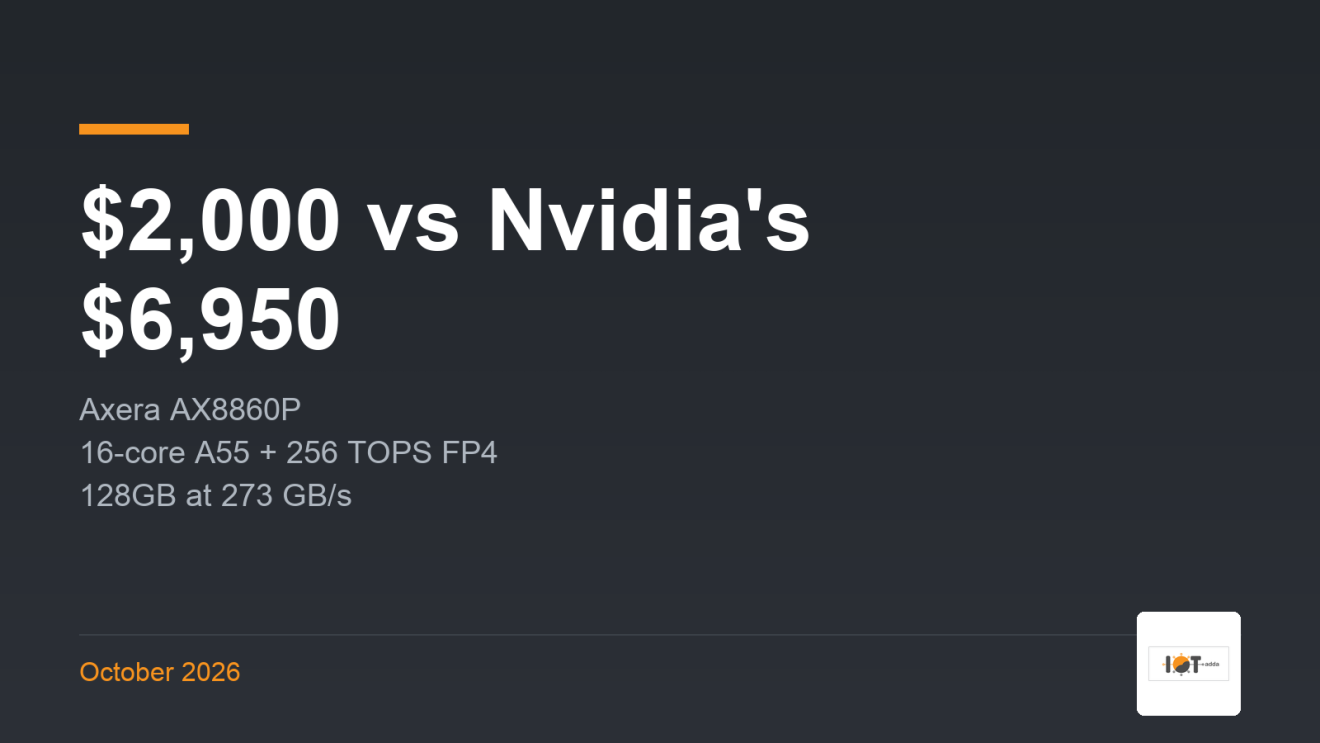
Axera’s AX8860P packs 16 Cortex-A55 cores and up to 128 GB of LPDDR5x at the same 273 GB/s bandwidth as the Spark. Its pitch isn’t more TOPS. It’s that Nvidia’s TOPS number isn’t the one that matters.
Axera’s AX8860P is a 6 nm, 16-core Arm Cortex-A55 SoC with an NPU rated at 128 TOPS, or 256 TOPS at FP4, in a 78 × 78 mm module drawing roughly 40 W under load. Sipeed is building it into a desktop machine called MaixStation, positioned directly against Nvidia’s DGX Spark.
The price gap is the headline. A DGX Spark now sells for $6,949.99. MaixStation is expected under $2,000 for 32 GB and around $4,000 for 128 GB. But the more interesting claim is about how the two should be compared at all.
The argument about TOPS
Nvidia advertises 1,000 TOPS for the DGX Spark. Axera’s counter is that this is a sparse FP4 figure, that real models cannot exploit sparse FP4, and that the dense number — roughly 500 on paper — is the one worth comparing. It further argues that even that figure is poorly utilised in practice.
Both machines have identical memory bandwidth at 273 GB/s. Axera’s position is that its architecture keeps more of that bandwidth busy, which is a claim about utilisation rather than peak specification.
It is worth being clear that this is a vendor framing a comparison in terms that favour it. But the underlying point is sound and we have made it here before: a peak TOPS figure describes a ceiling, not achievable throughput, and sparse-math numbers describe a ceiling most real workloads never reach.
What the benchmarks actually show
Sipeed’s own Qwen tests put MaixStation 128 GB only slightly ahead of a DGX Spark 128 GB, with MTP disabled. Slightly ahead, from the vendor’s own benchmark, at roughly half to two-thirds the price.
That is a more honest and more interesting result than a claimed multiple would be. The case here is not that this hardware is faster. It is that it is comparable, for considerably less money.
Specifications
| Parameter | Axera AX8860P |
| CPU | 16 × Arm Cortex-A55 |
| NPU | 128 TOPS, or 256 TOPS at FP4 |
| Memory | Up to 128 GB 256-bit LPDDR5x, 273 GB/s |
| Video | 64-channel decode, 16-channel encode |
| Interconnect | PCIe 5.0, plus AXLink chip-to-chip cascading at ~80% efficiency |
| Power | About 40 W under load |
| Process / package | 6 nm, 78 × 78 mm module |
| Software | vLLM, SGLang, PyTorch, ONNX, Hugging Face, OpenAI-compatible APIs |
Clustering is where the cost gap widens
The AXLink chip-to-chip interconnect cascades at about 80% efficiency, and Sipeed is planning multi-node configurations — a quad-node MaixStation Pro at 512 GB, and PCIe cards carrying up to four chips. Radxa has announced a Pocket Supercomputer on the same silicon.
Sipeed’s stated model fits give a sense of the target: 32 GB running a 27B Qwen model, 128 GB running 125B, dual nodes at 256 GB running DeepSeek V4-Flash at 284B, and quad nodes at 512 GB running 552B.
The cost argument compounds here. Clustering these needs a cable rather than the 200G or 400G switch a comparable Nvidia setup would require — and that switch alone is roughly $4,000.
The catch
MaixStation is not on sale. Sipeed plans a Kickstarter in a few months, with a $30 reservation fee securing a discount when the campaign opens. Everything above is a specification and a vendor benchmark, not a product anyone outside Sipeed has independently tested.
The IoTAdda take
For Indian AI teams and colleges, the number that matters here is not $2,000 against $6,950 — it is what a local inference box does to the cost of experimenting. A great deal of applied AI work in India runs on rented cloud GPUs because the capital cost of a local machine capable of holding a mid-sized model in memory has been prohibitive. A 128 GB box at around $4,000 that can hold a 125B model changes which institutions can afford to have one on a bench rather than on a credit card. That said, two cautions are worth stating plainly. This is unreleased crowdfunded hardware from a vendor whose software ecosystem is nothing like Nvidia’s in maturity, and the entire performance case currently rests on the vendor’s own benchmarks. The sensible posture is to watch the Kickstarter, wait for independent testing, and treat the $30 reservation as a lottery ticket rather than a procurement decision.
CNX Software — Axera AX8860P 16-core Cortex-A55 SoC takes on NVIDIA DGX Spark at fraction of the cost (2026-10-19) https://www.cnx-software.com/2026/10/19/axera-ax8860p-16-core-cortex-a55-soc-takes-on-nvidia-dgx-spark-at-fraction-of-the-cost/DGX Spark
Related articles
- WFI32 Standalone Wi-Fi MCU Modules20 January 2022
- Anthropic: Connect Claude to Notion, Canva, Linear, and Your Desktop15 July 2025
- Samsung Vision AI: Redefining Intelligent Screens for Smarter Living7 January 2025
- Microchip’s PolarFire SoC Discovery Kit: Affordable Access to RISC-V and FPGA for Embedded Engineers20 February 2024
- Nordic sets a new benchmark for Bluetooth Low Energy with nrf54 series18 April 2023