
ST’s VL53LB Is a 4 mm Time-of-Flight Sensor That Ranges Beyond 8 m. Samples Now, Sale in 2027
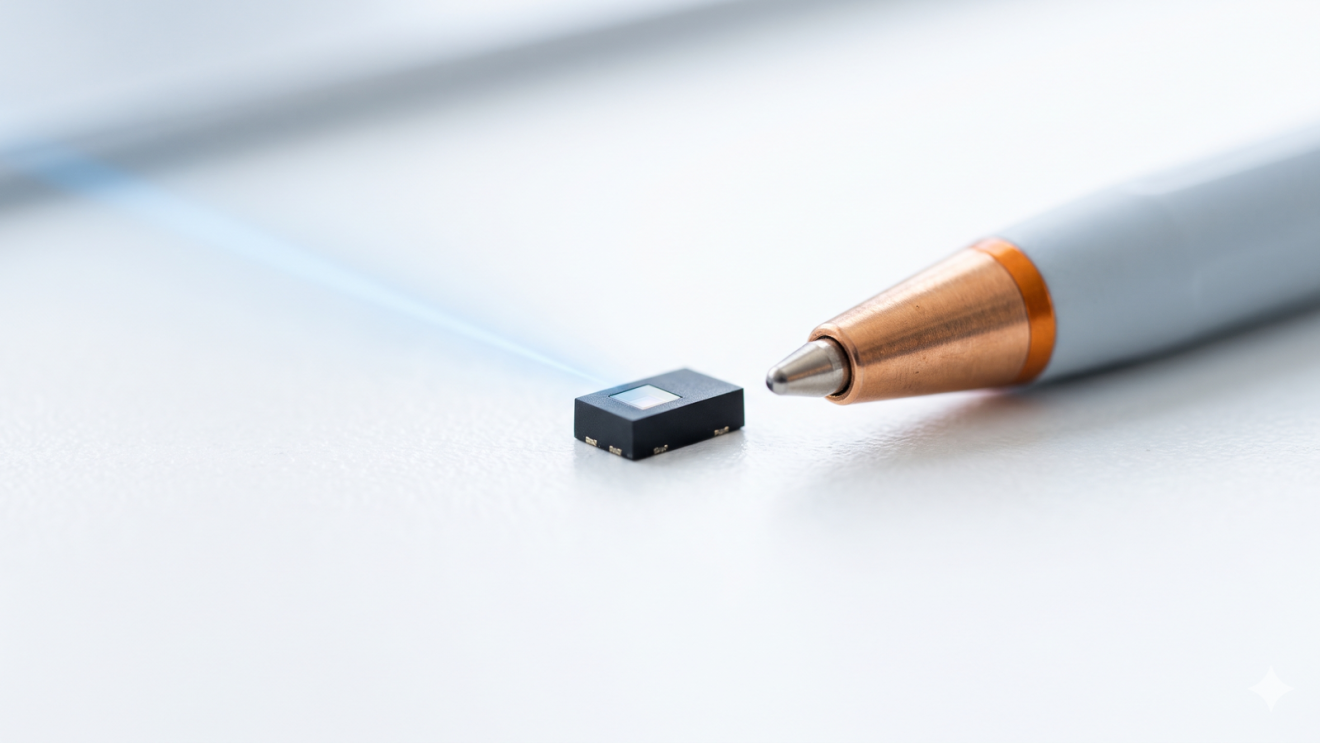
Key takeaways
- STMicroelectronics announced the VL53LB on 24 November 2026: a 4.0 × 1.8 × 1.0 mm single-zone direct time-of-flight sensor that ranges from under 5 mm to beyond 8 m and can detect multiple objects in its field of view.
- ST says the part is about 30% smaller than the previous generation and competitors, halves active-ranging power, and has an ultralow-power mode of as little as 50 µW. It supports I3C and needs no metal shielding can.
- Samples are available to selected OEMs now, with general availability through st.com planned for Q2 2027. ST has not published a price, and we found no public datasheet.
The ST VL53LB ToF sensor is the company’s smallest time-of-flight ranging sensor yet. ST announced it on 24 November 2026 as the part that completes its FlightSense portfolio, aimed at slimmer, lower-power devices. It is the fourth generation of ST’s single-zone sensors and uses the company’s SPAD technology, with the front end made on a 40 nm process in Crolles, France.
What ST says
The package integrates a CMOS sensor, a 940 nm infrared emitter and embedded processing. The measuring range runs from under 5 mm to beyond 8 m, with multi-object detection inside the field of view. ST says the footprint is about 30% smaller than the previous generation and competitors, active-ranging power is halved, and the ultralow-power mode needs as little as 50 µW. The part supports I3C, and, unlike some competing ICs, needs no metal shielding can.
The caveats
CNX Software reports that the 8 m range holds in a dark room only. In bright light ST says the sensor still ranges more than 1 m at 120 kLux, which is roughly full sunlight. Samples are available now to selected OEM customers, and general availability through st.com is planned for Q2 2027, so most makers will wait. ST has not published a price. We also found no public datasheet, so several figures reported by CNX, such as the 26° field of view and 43 mA in continuous ranging, are not confirmed by ST.
How it compares
| Part | Package (mm) | Range | Interface |
|---|---|---|---|
| VL53LB | 4.0 × 1.8 × 1.0 | Under 5 mm to beyond 8 m (dark room) | I2C and I3C |
| VL53L0X | 4.4 × 2.4 × 1.0 | Up to 2 m | I2C, up to 400 kHz |
| VL53L1X | 4.9 × 2.5 × 1.56 | Up to 4 m | I2C, up to 400 kHz |
| VL53L4CD | 4.4 × 2.4 × 1.0 | Up to 1.3 m | I2C, up to 1 MHz |
The older figures come from ST’s datasheets. The VL53LB will not be a drop-in swap for them: the footprint is different, and CNX reports 1.8 V and 3.3 V operation, which ST has not confirmed, against the 2.6 to 3.5 V of the older parts. ST names cameras and autofocus, presence sensing, obstacle detection, robotics and industrial automation as targets. CNX adds smart toilets, dispensers and liquid-level sensing.
ST also cites a forecast from Anas Chalak of Yole Group that annual shipments of ToF-enabled devices will exceed 665 million units by 2031.
Key specifications
| Spec | Value |
|---|---|
| Technology | Single-zone direct ToF, 4th-generation FlightSense, 940 nm emitter |
| Package | 4.0 × 1.8 × 1.0 mm |
| Range | Under 5 mm to beyond 8 m; multi-object detection |
| Bright-light range | More than 1 m at 120 kLux (ST) |
| Low-power mode | As little as 50 µW |
| Interface | I3C supported (I2C per CNX) |
| Availability | Samples now to selected OEMs; st.com Q2 2027 |
| Price | Not published by ST. For reference, a VL53L0X breakout was ₹132 and a VL53L1X breakout ₹880 at Robocraze on 25 November 2026 |
ST has published no price for the VL53LB, so no INR conversion is possible. Reference prices are for older sensors on breakout boards from one Indian seller and will vary by shop and stock.
Why it matters for India
Indian makers know ToF sensors through the VL53L0X and VL53L1X breakout boards, which sell for a few hundred rupees, so the VL53LB’s size and range will interest wearable, robot and smart-washroom designers once it is on the shelf.
Until Q2 2027, only OEMs working with ST’s local representatives can get samples, so Indian start-ups should ask early rather than wait for retail listings.
Our view
The VL53LB is a real step for tight designs, but treat 8 m as a dark-room figure, not a product spec for outdoor use. Judge it on the datasheet when ST publishes one, especially supply voltage, field of view and current in ranging mode. Until then, keep prototypes on the VL53L1X.
Related reading
- Arduino Goes Industrial: Nano XL Link Puts CAN FD, RS-485 and Ethernet on a 43 mm Board
- Nordic’s nRF71 Puts Wi-Fi 6, BLE, Thread and an NPU on One Chip at 20x Lower Standby Power
- electronica 2026: 6 Embedded Launches Worth an Engineer’s Attention
- ESP32-S31 Dev Kits Are Arriving: What the Chip Gives You, and Which ESP32 to Buy in 2026
Sources
- STMicroelectronics: STMicroelectronics introduces VL53LB, its smallest Time-of-Flight ranging sensor that completes the FlightSense portfolio, 2026-11-24
- CNX Software: ST VL53LB is the smallest FlightSense ToF ranging sensor at just 4.0 × 1.8 × 1.0 mm, 2026-11-24
- STMicroelectronics: VL53L0X datasheet (DS11555), 2024-06-01
- STMicroelectronics: VL53L1X datasheet (DS12385), 2024-08-01
- STMicroelectronics: VL53L4CD datasheet (DS13812), 2022-01-01
- Robocraze: VL53L0X Laser Ranging Sensor, 2026-11-25
- Robocraze: 7Semi VL53L1X ToF breakout, 2026-11-25
Representative image, AI-generated.
Related articles
- Microcurrent humidity sensor14 November 2015
- Capacitive sensor IC10 November 2015
- Panasonic Unveils Ultra-Compact, Long-Lasting Air Quality Sensor: SN-GCQB127 November 2024
- electronica 2026: 6 Embedded Launches Worth an Engineer’s Attention17 November 2026
- Vishay’s Latest RGB LED Brings 70% More Brightness in a 22% Smaller Package17 July 2025