
Arduino Goes Industrial: Nano XL Link Puts CAN FD, RS-485 and Ethernet on a 43 mm Board
Key takeaways
- The Arduino Nano XL Link (ABX00182) runs Microchip’s PIC32CK2051SG01144 Arm Cortex-M33 at 120 MHz, with 2 MB flash, 512 kB RAM and a hardware security module.
- Three transceivers sit on a 43 × 23 mm board: TI TCAN3414 for CAN FD, TI THVD2410 for RS-485 and a Microchip KSZ8081 10/100 Ethernet PHY; it takes 7–24 V DC on VIN.
- Announced at electronica in Munich on 10 November 2026 with a DIN-rail Connector Carrier (ASX00090); Arduino has not yet published a price or ship date.
The Arduino Nano XL Link is a Nano-sized board with CAN FD, RS-485 and 10/100 Ethernet transceivers on board, so a sketch can talk to a motor drive, an energy meter or a building-management bus without add-on shields. Arduino announced it at electronica in Munich on 10 November 2026, with a DIN-rail carrier, for industrial, home and building automation.
A Microchip Cortex-M33 at the centre
The MCU is Microchip’s PIC32CK2051SG01144, an Arm Cortex-M33 at 120 MHz with 2 MB flash, 512 kB RAM and a hardware security module that Arduino says handles secure boot and key storage. CNX Software reports 728 kB of flash is free for sketches.
Alongside sit a TI TCAN3414 CAN FD transceiver, a TI THVD2410 half-duplex RS-485 transceiver and a Microchip KSZ8081RNAIA Ethernet PHY. The 120 Ω bus terminations are on by default and set by solder jumpers. The datasheet does not mention galvanic isolation.
Nano footprint, more pins
The board keeps the 43 × 23 mm outline but uses two double-row 2×15 headers, 60 pins in all, adding 12 digital pins, a second SPI bus, I2C, a second UART, I2S and the fieldbus lines. It takes 5 V over USB-C or 7–24 V DC on VIN, and is rated for −20 °C to +85 °C.
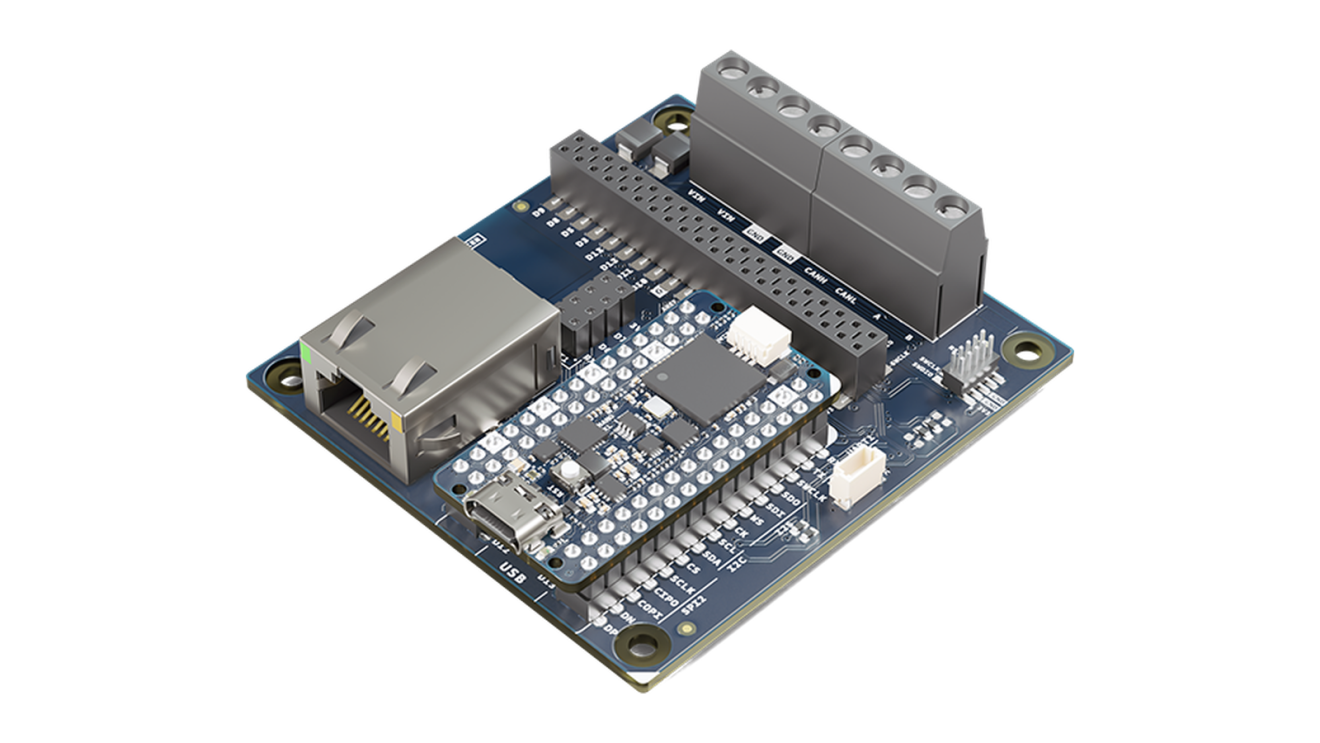
The Ethernet magnetics and RJ45 jack are not on the board. They sit on the Nano XL Link Connector Carrier, which adds DIN-rail mounting, CAN and RS-485 screw terminals and an ESP-01-style Wi-Fi header, and doubles as a reference design.
Software, and what is missing
Code goes in from the Arduino IDE or Cloud Editor on the Arduino Zephyr core. The datasheet says the board does not support over-the-air updates. Arduino has not published a price or ship date.
Key specifications
| Spec | Arduino Nano XL Link (ABX00182) |
|---|---|
| MCU | Microchip PIC32CK2051SG01144, 32-bit Arm Cortex-M33, 120 MHz |
| Memory | 2 MB flash, 512 kB RAM |
| Security | Integrated hardware security module (secure boot, key storage) |
| CAN FD | TI TCAN3414 transceiver, 120 Ω termination (jumper) |
| RS-485 | TI THVD2410 half-duplex transceiver, 120 Ω termination (jumper) |
| Ethernet | Microchip KSZ8081RNAIA 10/100 PHY; RJ45 and magnetics on carrier |
| Headers | Two 2×15 double-row, 2.54 mm (60 pins); Qwiic; USB-C |
| Analog / PWM | 8 analog inputs (up to 12-bit), 8 PWM pins |
| Power | 5 V via USB-C or 7–24 V DC on VIN; 3.3 V I/O |
| Size / temperature | 43 × 23 mm; −20 °C to +85 °C |
| Software | Arduino IDE, Arduino Cloud Editor, Arduino Zephyr core; no OTA |
| Companion | Nano XL Link Connector Carrier (ASX00090), DIN-rail |
| Price | Not announced (no USD/EUR price published; INR to follow) |
| Availability | Not announced |
Sources: Arduino datasheet ABX00182 (modified 13/11/2026), Arduino Docs, Arduino blog (10 Nov 2026). Once Arduino publishes a price, convert at ₹93.70/$ (PTI, 11 Nov 2026) or a dated EUR rate; Indian street price will differ (duty, GST).
Why it matters for India
Most energy meters, VFDs and temperature controllers in Indian plants already speak Modbus RTU over RS-485, so a board with the transceiver, termination and a DIN-rail carrier ready fits the retrofit monitoring and gateway jobs that small machine builders and building-automation integrators quote every week.
It also lets students who learnt on Arduino wire a real CAN FD or RS-485 bus from the same IDE, which is closer to what plant automation teams hire for; the landed rupee price after duty and GST will decide how far it spreads.
Our view
This is the right board for Arduino to build: the hard part of an industrial gateway is not the MCU but the transceivers, terminations, wide-input supply and a rail-mounted carrier, and Arduino has packaged all of it. Two choices hold it back. No OTA means every firmware fix is a site visit with a laptop, which is what remote-monitoring customers pay to avoid. And unmentioned isolation matters on noisy shop floors with long RS-485 runs. Today it is an excellent prototyping and low-volume gateway board, not a PLC substitute. Add OTA and price it near a Nano rather than an Opta, and it becomes the default start for Indian Modbus-to-cloud projects.
Related reading
- Low Cost, High Impact: IoT in Indian Manufacturing
- McKinsey Warns: IIoT Can’t Grow Without Talent—Here’s Why Upskilling Must Start Now
- Espressif’s $2 ESP32-C61-MINI Puts Wi-Fi 6 and Bluetooth 5.3 Into a 13 mm Module
- Thailand’s AI IoT Leap: A Wake-Up Call for Indian Manufacturers
Sources
- Arduino Blog: Just announced at electronica: the Arduino Nano family is now XL!, 2026-11-10
- Arduino: Arduino Nano XL Link (ABX00182) datasheet, 2026-11-13
- Arduino Docs: Nano XL Link, 2026-11
- CNX Software: Arduino Nano XL board features Microchip PIC32CK Cortex-M33 MCU for industrial, home, and building automation, 2026-11-11
The Nano XL Link on its Connector Carrier, which adds the RJ45 jack, CAN and RS-485 screw terminals and DIN-rail mounting. Image: Arduino (CC BY-SA 4.0).
Related articles
- Microchip’s PolarFire SoC Discovery Kit: Affordable Access to RISC-V and FPGA for Embedded Engineers20 February 2024
- STMicroelectronics Introduces STM32L4+ Microcontrollers: Power- and Cost-Sensitive Smart Embedded Applications13 March 2020
- electronica 2026: 6 Embedded Launches Worth an Engineer’s Attention17 November 2026
- A $2,000 Desktop AI Box Is Going After Nvidia’s $6,950 DGX Spark — and the TOPS Argument Is the Interesting Part22 October 2026
- WFI32 Standalone Wi-Fi MCU Modules20 January 2022