
MeitY Rewrites the ‘Made in India’ Test for Laptops, PCs and Servers. Design and R&D Now Count
Key takeaways
- On 20 November 2026 MeitY revised how domestic value addition is calculated for six IT hardware products under the Public Procurement (Make in India) Order: desktops and all-in-ones, laptops, thin clients, servers, monitors and interactive flat panel displays.
- The new method credits named processes done in India, including SMT motherboard assembly, local bare PCBs, RAM and SSD assembly and test, display assembly, local chassis and power modules, and final assembly and test, plus R&D and Indian design and IP.
- It takes effect six months after publication in the Gazette and replaces MeitY’s 7 September 2020 notification for these products; the weightage for each process has not been published.
The Ministry of Electronics and IT (MeitY) has changed how domestic value addition is measured for laptops, PCs, servers and monitors sold to the government. The revised methodology, announced on Friday, 20 November, replaces a 2020 formula with “a process-oriented, Bill of Materials (BoM)-based mechanism” that gives credit for specific manufacturing steps done in India, for in-house R&D, and for Indian product design and intellectual property.
What changed
The method covers six products: desktop and all-in-one PCs, laptops, thin clients, servers, computer monitors and interactive flat panel displays. According to the ministry’s statement, as carried by ETTelecom and the ANI and IANS wires, it recognises these activities in India:
- Motherboard (mainboard) assembly by surface-mount technology (SMT)
- Domestic sourcing of bare PCBs
- Assembly, testing and packaging of memory (RAM) and storage (SSD)
- Display assembly processes
- Domestic sourcing of chassis and power modules
- Final assembly and testing
On top of these, the ministry says the method gives “adequate weightage” to eligible in-house R&D in India and “additional weightage” to Indian product design and IPR. Manufacturers will calculate value addition in a standard format and self-certify it, with verification “wherever required”. The method takes effect six months after it is published in the official Gazette and supersedes the 7 September 2020 notification for these six products.
Why the number matters
Domestic value addition decides who gets preference in government purchases under the Public Procurement (Preference to Make in India) Order, 2017. Under the order as revised in 2020, a Class-I local supplier has local content of 50% or more; a Class-II supplier has more than 20% but less than 50%. A 2024 revision excluded imported items bought from local resellers, royalties and fees paid abroad, and rebranded or repackaged goods from local content.
The 2020 method was already based on the bill of materials, but it worked mainly by capping imported parts: the processor could count for no more than 30% of a desktop’s BoM and 35% of a laptop’s, and the panel no more than 35% of a monitor’s. The new method shifts the emphasis to which processes are done in India and adds credit for design and R&D.
Where it fits with PLI and import controls
The change sits alongside two other levers. The IT hardware PLI 2.0 scheme, with an outlay of ₹16,939 crore, had attracted ₹1,056 crore of investment and ₹24,385 crore of production by 30 June 2026, with 5,216 direct jobs, according to a Lok Sabha answer in July. Laptop, PC and server imports have needed authorisation since November 2023; the current window runs to 15 December 2026, with authorisations valid to 31 December 2026.
Arjun Malhotra, HCL co-founder and chairperson of the EPIC Foundation, welcomed the change: “For years, we have assembled hardware in India that was designed somewhere else. MeitY’s revised methodology is a move in the right direction to improve domestic design and content in these electronic devices.”
What we do not know yet
- The weightage for each process, and for R&D and design. No table has been published.
- The Gazette date, and so the date the method takes effect.
- How R&D and design claims will be verified beyond self-certification.
- Reactions from the large laptop and server makers. None had been reported by 21 November.
Why it matters for India
The design and IP credit is the part engineers should watch. If it carries real weight, a laptop or server designed in India earns more procurement preference than one only assembled here, and that creates paid work in board design, BIOS and firmware, mechanical design and validation, not just on the assembly line.
The local bare PCB credit arrives just as India’s PCB supply is tight and mostly imported. Brands will look for Indian board fabricators; the new plants approved under the component scheme need to be ready to take those orders.
Interactive flat panels are on the list. They sell in large numbers to schools and government offices, so Indian display and IFPD makers stand to gain if the weightages reward local assembly and design.
Our view
This is the right direction: it rewards what Indian engineers do, not only what Indian factories bolt together. But a method is only as good as its weightages and its checks, and neither is public yet. MeitY should publish the weightage table with the Gazette notice, require the R&D and design claims to be backed by named teams and filed IP, and audit a sample of self-certifications each year. If design credit can be claimed for re-skinning a reference design, the rule will change paperwork, not products.
Related reading
- India’s Electronics Exports Jump 44% to $31.97 Billion. The Real Story Is PCBs and Memory Chips
- India Opens Semicon 2.0 for Fabs and OSAT, Clears 12 Component Plants Worth ₹7,503 Crore
- 1.3 Lakh Jobs: How PLI Is Reshaping India’s Electronics Industry
- India Signs the San Francisco Declaration on Chip Supply Chains. What Engineers Should Watch
Sources
- ETTelecom: MeitY updates local content norms for key IT hardware products, aims to support indigenous R&D, 2026-11-20
- The Tribune (ANI): MeitY revises domestic value addition norms for six IT hardware products to boost local manufacturing, 2026-11-20
- Social News XYZ (IANS): IT ministry revises domestic value addition norms for 6 IT hardware products, 2026-11-20
- DPIIT: Public Procurement (Preference to Make in India) Order, revised 4 June 2020, 2020-06-04
- Lok Sabha: Unstarred Question 1695: PLI scheme for IT hardware, 2026-07-29
- TaxGuru: Import authorisation mandated: restricted IT hardware remains under IMS for 2026, 2025-12-17
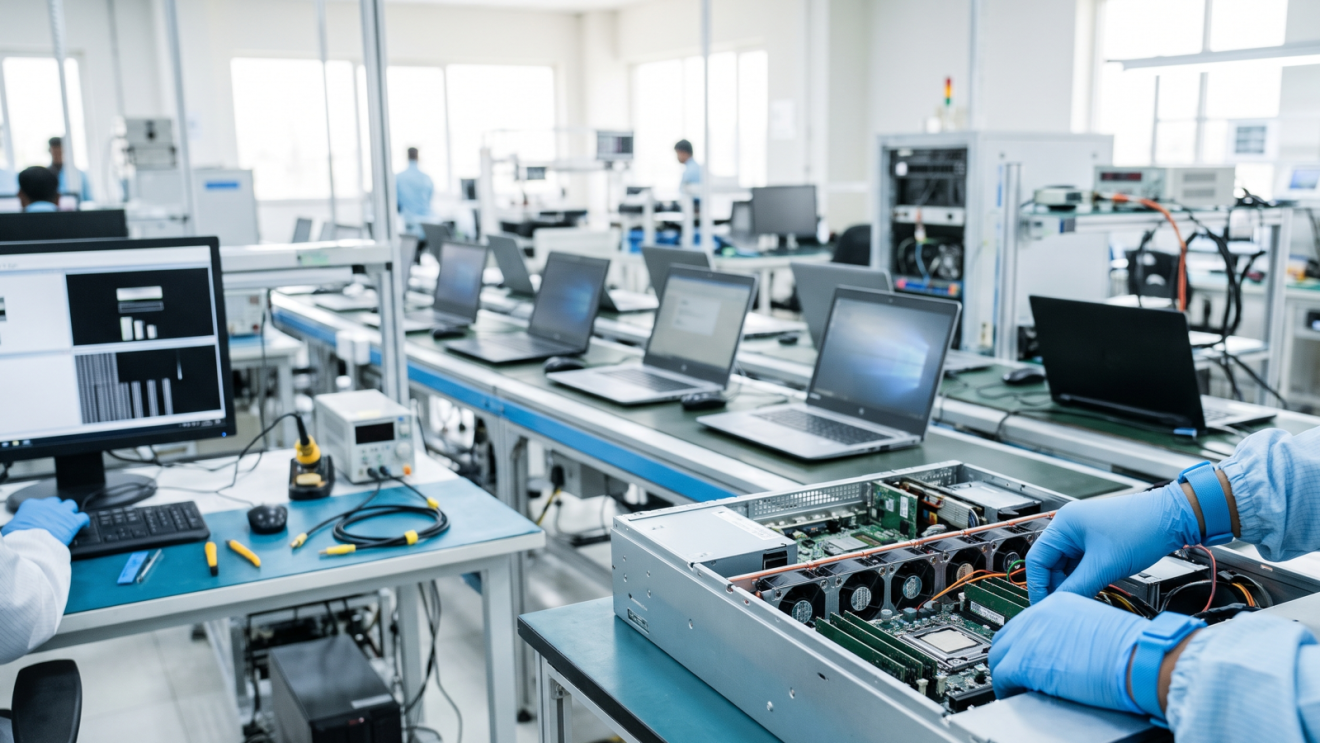
Representative image, AI-generated.
Related articles
- PCB Prices Are Up Almost 40% and Lead Times Have Stretched. What Indian Hardware Teams Can Do21 November 2026
- India’s Electronics Exports Jump 44% to $31.97 Billion. The Real Story Is PCBs and Memory Chips19 November 2026
- Kaynes to Build ₹4,995 Cr Electronics Manufacturing Unit in Tamil Nadu: Jobs, Growth, Stability4 August 2025
- Electronics Jobs in India Just Got Safer: US Keeps Tariff-Free Access31 July 2025
- 1.3 Lakh Jobs: How PLI Is Reshaping India’s Electronics Industry28 July 2025