
PCB Prices Are Up Almost 40% and Lead Times Have Stretched. What Indian Hardware Teams Can Do
Key takeaways
- Printed circuit boards cost almost 40% more than before the shortage, and lead times run to 12 weeks or more, according to industry executives quoted by BusinessLine on 19 November 2026.
- The squeeze comes from AI server boards absorbing copper-clad laminate, glass cloth and resin, plus the spring 2026 shutdown of a Saudi plant that makes about 70% of the world’s high-purity PPE resin (Reuters).
- India imports roughly 80-88% of its PCBs; Syrma SGS expects the shortage to ease around mid-2027, while laminate suppliers point to late 2027 or 2028.
The PCB shortage that began early this year has reached Indian hardware makers’ purchase orders. Printed circuit boards now cost “almost 40 per cent higher”, Richard Puthota, Senior Director at MacDermid Alpha, told BusinessLine on 19 November, and suppliers are prioritising data centre builders, so other buyers face lead times “as long as 12 weeks”. The Indian Printed Circuit Board Association (IPCA) says some smaller Indian PCB factories are on the verge of closure.
Why boards got expensive
A PCB starts as copper-clad laminate (CCL): glass cloth soaked in resin and clad with copper foil. TrendForce puts copper foil at about 42% of laminate cost, resin at about 26% and glass cloth at about 19%. All three are under pressure at once.
- AI servers. Boards for AI servers use three to five times the layers of conventional boards, according to a Würth Elektronik study reported by Evertiq, and laminate makers are shifting capacity to the low-loss materials those boards need.
- Resin. Reuters reported in April that a strike on Saudi Arabia’s Jubail petrochemical complex halted production of high-purity PPE resin; SABIC makes about 70% of the world’s supply. Epoxy resin lead times at one Korean board maker went from 3 to 15 weeks.
- Copper. Copper foil was up as much as 30% in 2026 by April, per Reuters.
- Glass cloth. Thin 1080-grade glass cloth is up about 300% from low to peak, Taiwan’s CTEE reported in October, because weaving capacity is limited.
The result shows up in laminate price lists. Korea’s import price for CCL was 74.5% higher in March than a year earlier, according to Korea Customs data cited by TrendForce. Nan Ya Plastics raised CCL prices 20% from 1 September, and CTEE reported a further 10-15% rise expected from November. By August, Evertiq reported, the shortage had spread from advanced laminates to standard FR-4.
| Input | What happened in 2026 | Source |
|---|---|---|
| Finished PCBs | Up as much as 40% in April vs March | Goldman Sachs via Reuters, 27 Apr |
| High-purity PPE resin | Saudi plant with ~70% of world supply halted | Reuters, 27 Apr |
| Copper foil | Up as much as 30% by April | Reuters, 27 Apr |
| CCL (Korea import price) | +74.5% year on year in March | Korea Customs via TrendForce, 6 May |
| CCL (Nan Ya) | +20% from 1 September | SMM, 14 Aug |
| Thin 1080 glass cloth | About +300% low to peak | CTEE via Taiwan News, 23 Oct |
What it means in India
India buys most of its boards abroad. Industry players quoted by BusinessLine put demand at about $8 billion with almost 80% imported; an ELCINA report to the government put FY25 demand at ₹35,000 crore with 88% imported. Either way, Indian assemblers pay the global price, and local fabricators pay it for their laminate.
IPCA president Rajneesh Garg warned of “a steep rise in prices of electronic goods to the extent that sales will be impacted. We are already seeing it happen.” He also called for zero duty on PCB inputs that still carry duty. Earlier this year IPCA advised fabricators to seek price increases of 45-50% from customers and reported delivery windows of up to 20 weeks, according to reports in June.
When it may ease, and the new capacity coming
Estimates differ. Jasbir Singh Gujral, MD of Syrma SGS, expects the shortage to ease around mid-2027. CTEE’s laminate sources see gradual relief from the second half of 2027 into 2028, and the Würth study does not expect glass fabric constraints to ease significantly before 2028.
Domestic capacity is on the way under the component manufacturing scheme. The first round of approvals, in October 2025, included India’s first CCL plant; the minister said that round would meet 20% of domestic PCB demand. The January 2026 round approved PCB projects for nine companies, including AT&S India, Epitome, Shogini and India Circuits, and a CCL project for Wipro, which received another ₹1,033 crore in August. Syrma SGS’s own PCB plant in Andhra Pradesh is due to start trial production in Q4 FY27, with volume production in FY28.
What hardware teams can do now
Supply-chain advisers writing in Evertiq and I-Connect007 this year give consistent advice:
- Approve equivalent laminates where the design allows, and specify the performance you need rather than one brand of material.
- Qualify alternative laminates and a second fabricator before a shortage forces the decision.
- Share realistic forecasts and release orders earlier; expect short quote validity and some prices confirmed only at delivery.
Our own suggestion, not from those sources: check whether your stack-up depends on thin glass styles such as 1080 or 2116 prepreg, which are among the tightest materials, and ask your fabricator whether an equivalent construction is available.
Why it matters for India
For Indian product startups the real damage is not the 40%; it is the 12 to 20 weeks. A prototype spin that used to take two weeks can now hold up a pilot for a quarter, and small companies cannot place the advance orders big EMS firms can.
The ECMS plants are the right answer but arrive in 2027-28. Until then, a design that can accept two or three qualified laminates is cheaper insurance than any price negotiation.
IPCA’s warning about small fabricators matters to engineers too: they are the ones who take low-volume, quick-turn orders. If some close, prototype lead times stay long even after prices ease.
Our view
This is not a price spike that passes in a quarter; it is AI servers taking first claim on the same laminate, glass and resin that every other board needs, and the suppliers are telling us it lasts into 2027 or 2028. Indian hardware teams should treat board supply the way they treat chip supply: qualify alternates, keep a small buffer of critical boards, and design for availability, not just for performance. The government should act on IPCA’s request to remove duty on PCB inputs quickly, because the domestic fabricators it is funding under ECMS need to survive the next 18 months to matter.
Related reading
- India’s Electronics Exports Jump 44% to $31.97 Billion. The Real Story Is PCBs and Memory Chips
- India Opens Semicon 2.0 for Fabs and OSAT, Clears 12 Component Plants Worth ₹7,503 Crore
- India Signs the San Francisco Declaration on Chip Supply Chains. What Engineers Should Watch
- Kaynes to Build ₹4,995 Cr Electronics Manufacturing Unit in Tamil Nadu
Sources
- The Hindu BusinessLine: AI boom, West Asia conflict pushes PCB costs up by almost 40%, 2026-11-19
- Reuters (via The Star): Iran war disrupts the circuit board supply chain, raises costs for tech firms, 2026-04-27
- TrendForce: AI demand tightens CCL supply, drives advance orders, price hikes and expansion, 2026-05-06
- TrendForce: Iran disruptions reportedly push key resin materials up 40% since March, 2026-05-13
- Taiwan News (CTEE): Glass cloth and CCL prices to rise again from November, 2026-10-23
- Evertiq: PCB material shortage spreads to standard FR-4 as structural shift deepens, 2026-08-19
- Evertiq: PCB material shortages intensify as AI infrastructure absorbs laminate capacity, 2026-09-08
- I-Connect007: Advanced and conventional PCBs do not exist in separate supply chains, 2026-10-08
- Outlook Business (PTI): India needs 10-12 new big PCB units with ₹20k cr investment to cut reliance on imports, 2025-12-30
- Beebom (ET report): Indian PCB manufacturers seek price hikes amid supply chain crisis, 2026-06-04
- PIB (via NeGD): ECMS approvals, tranche 1, 2025-10-27
- PIB (via NeGD): ECMS approvals, tranche 3, 2026-01-02
- ThePrint (PTI): Govt clears 31 electronics component projects worth ₹7,877 cr, 2026-08-17
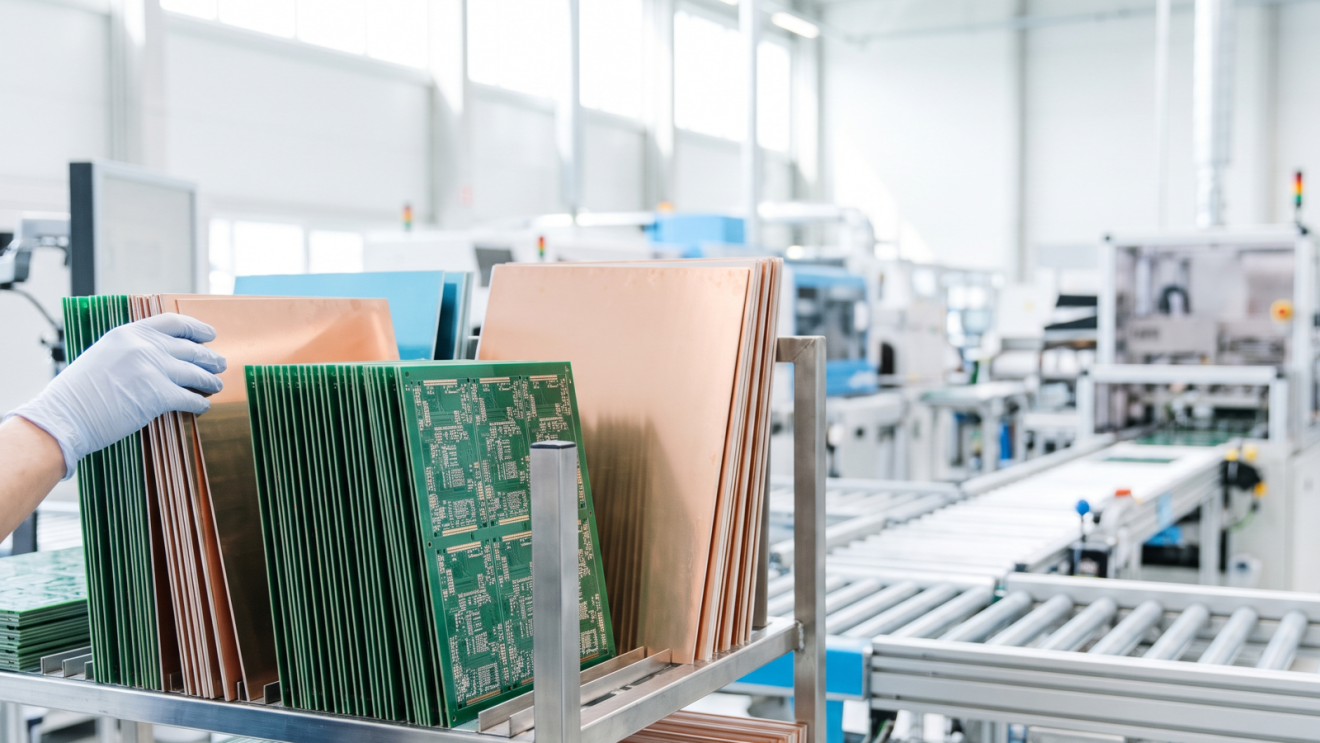
Representative image, AI-generated.
Related articles
- India’s Electronics Exports Jump 44% to $31.97 Billion. The Real Story Is PCBs and Memory Chips19 November 2026
- Kaynes to Build ₹4,995 Cr Electronics Manufacturing Unit in Tamil Nadu: Jobs, Growth, Stability4 August 2025
- Electronics Jobs in India Just Got Safer: US Keeps Tariff-Free Access31 July 2025
- 1.3 Lakh Jobs: How PLI Is Reshaping India’s Electronics Industry28 July 2025
- Tech Transfer or Nothing: India’s New China Policy23 July 2025