
India’s Electronics Exports Jump 44% to $31.97 Billion. The Real Story Is PCBs and Memory Chips
Key takeaways
- India’s electronic goods exports rose 44% to $31.97 billion in April to September 2026 (H1 FY27), from $22.20 billion a year earlier, according to Commerce Ministry data reported on 17 November.
- Non-smartphone electronics grew 56.5% to $13.79 billion, faster than smartphones (+35.8% to $18.17 billion), lifting their share of exports to 43.2% from 39.7%.
- Mounted PCB exports rose from $63.3 million to $2.10 billion and memory IC exports from $23.1 million to $562.4 million; both start from small bases and the commodity data are provisional.
India electronics exports grew 44% in the first half of this financial year, to $31.97 billion between April and September 2026, up from $22.20 billion a year earlier. The figures come from Commerce Ministry data reported by PTI and ET Manufacturing on 17 November. Smartphones remain the largest item. The more interesting change is underneath: circuit boards, memory chips, storage devices and networking equipment grew much faster than phones.
Phones still lead, but their share is falling
Smartphone exports rose 35.8% to $18.17 billion. Everything else grew 56.5% to $13.79 billion. As a result, phones fell to 56.8% of electronics exports from 60.3%, and the rest rose to 43.2% from 39.7%. The ministry called it “an increasingly diversified export basket”.
| Product (April to September) | FY26 | FY27 | Change | Largest destination |
|---|---|---|---|---|
| Smartphones | $13.38 bn | $18.17 bn | +35.8% | Not given |
| All other electronics | $8.81 bn | $13.79 bn | +56.5% | Not given |
| Mounted printed circuit boards | $63.3 mn | $2.10 bn | About 33x | Singapore ($1.87 bn) |
| Populated (loaded) printed circuit boards | $213.7 mn | $864.1 mn | +304% | China ($789.2 mn) |
| Network transmission and routing equipment | $732.9 mn | $1.45 bn | +98% | Hong Kong ($857.7 mn) |
| Memory integrated circuits | $23.1 mn | $562.4 mn | +2,333% | Malaysia ($390.8 mn) |
| Solid-state non-volatile storage | $14.6 mn | $260.5 mn | +1,680% | China ($108.6 mn) |
Source: Commerce Ministry data as reported by ET Manufacturing and PTI, 17 to 18 November 2026. Commodity-level figures are provisional.
Boards and memory, not just finished products
For an engineer, the board-level lines matter most. A mounted or populated PCB is a sub-assembly that goes into someone else’s product. Exporting $2.10 billion of mounted boards and $864 million of populated boards in six months means Indian assembly lines are winning work in the middle of other companies’ supply chains, not only at the end.
Memory is the other surprise. Memory IC exports went from $23.1 million to $562.4 million, and solid-state storage from $14.6 million to $260.5 million. The rise coincides with Micron’s assembly and test plant at Sanand in Gujarat, which began commercial production and shipped its first memory modules on 28 February 2026. No official source links the two, so treat that as timing, not proof.
Read the percentages with care
Increases of 2,333% and 1,680% sound dramatic because they start from very small bases. The destinations need care too. Singapore, Hong Kong and Malaysia are regional trading and logistics hubs, so the country in the export data is not necessarily where a board or chip ends up. The data do not say where these products are finally used.
Imports are the other side of the ledger. In FY26 India exported $48.0 billion of electronics and imported $116.17 billion. Imports in April to June 2026 alone were $38.46 billion, up 43.7%. Domestic value addition in electronics is estimated at only 18 to 20%, because displays, memory, PCBs and processors are still largely imported. That is the gap the component manufacturing scheme is meant to close.
Where this sits against the targets
Electronics is now India’s third-largest export category, and mobile phones were the largest single export product in FY26. The government is aiming for $500 billion of electronics and semiconductor production by 2030, from about $330 billion today, and the Commerce Ministry has begun consulting industry on a roadmap for $150 billion of electronics exports by 2030. At the current half-year pace, FY27 exports would be well above FY26’s $48 billion, but still far from $150 billion.
Why it matters for India
Board-level exports change what Indian EMS companies hire for. Surface-mount process engineers, test and in-circuit test developers, and design-for-manufacture skills become the bottleneck, not just line operators.
For product startups, more export-grade PCB assembly capacity at home should mean better quality and faster turnaround for local prototypes and small batches. The catch is that the memory and processors on those boards are still mostly imported.
The value-addition figure is the one to watch. A 44% export rise with imports rising almost as fast is assembly growth; a rising share of locally made components is industrial growth.
Our view
The 44% headline will be quoted everywhere. I would quote two other numbers instead: non-smartphone exports now 43% of the total, and $2.96 billion of circuit boards in six months. They show India starting to sell sub-assemblies into other people’s products, which is how Taiwan and Malaysia built their electronics industries. The government should publish value-addition data alongside export data every quarter, so we can see whether components are following the assembly lines. For engineers, the practical signal is to learn the skills of the middle of the chain: board test, yield, DFM and supply-chain traceability.
Related reading
- India Opens Semicon 2.0 for Fabs and OSAT, Clears 12 Component Plants Worth ₹7,503 Crore
- India Needs 100,000 Chip Jobs in Three Years. Most Are Not in Chip Design
- India Signs the San Francisco Declaration on Chip Supply Chains. What Engineers Should Watch
- Tata Electronics’ ₹27,000 Crore Jagiroad ATMP Plant Targets Production in FY2026–27
- 1.3 Lakh Jobs: How PLI Is Reshaping India’s Electronics Industry
Sources
- ET Manufacturing: India’s electronic goods exports jump 44% to $31.97 billion in H1 FY27, 2026-11-17
- Millennium Post (PTI): Electronic exports rise 44% to $31.97 billion in April-Sept of current financial year, 2026-11-18
- Upstox News: Non-smartphone electronics exports surge 56.5%, outpace smartphones in April-Sep, 2026-11-18
- Organiser (PMO release): PM Modi inaugurates Micron’s semiconductor ATMP facility; commercial production begins, 2026-02-28
- Angel One: India electronics trade FY26: imports surge to $116 billion, exports grow 24%, 2026-04-16
- The Week: Electronics trade deficit FY25-26, 2026-04-16
- ThePrint: India’s imports from China grew by 28% in first quarter of FY27, 2026-07-13
- IANS: India eyes $500 billion electronics manufacturing by 2030, 2026-07-30
- Angel One: Government, industry brainstorm roadmap for $150 billion electronics exports, 2026-07-11
- KNN India: India’s electronics exports surge over 11-fold since FY15, 2026-08-14
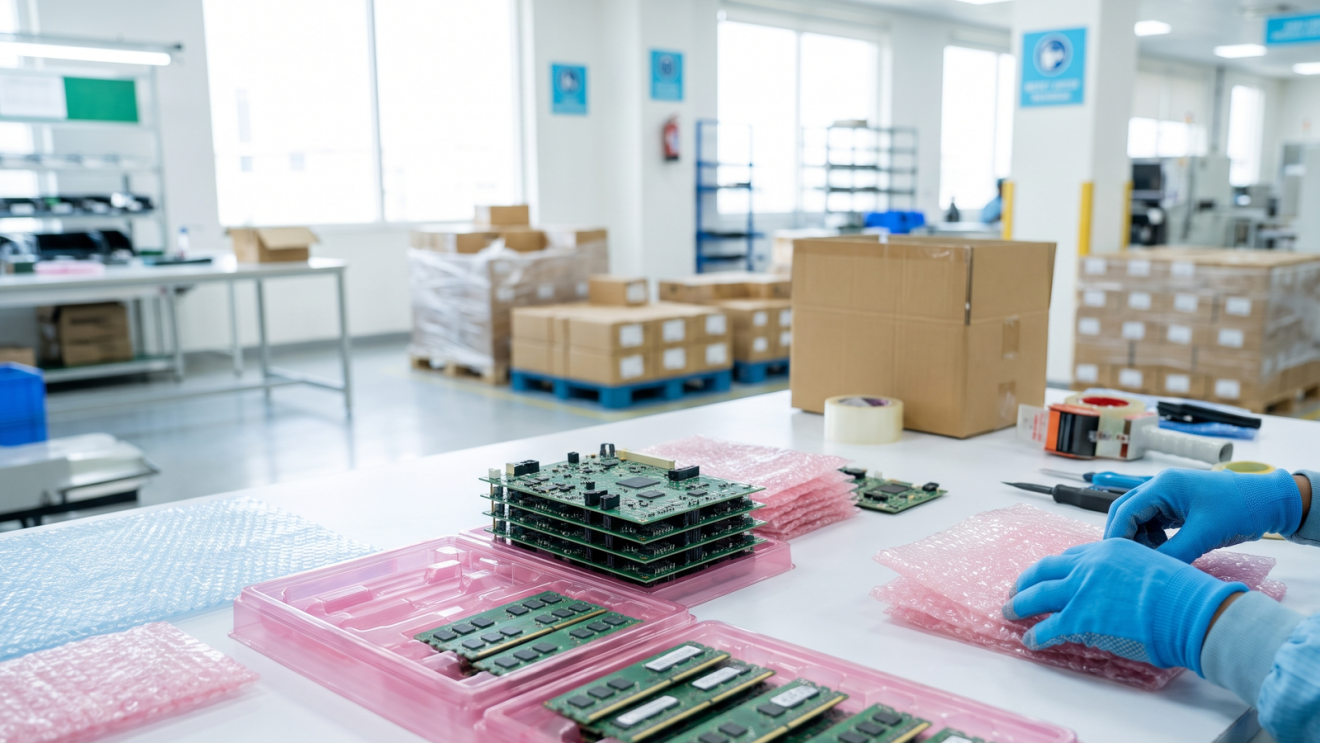
Representative image, AI-generated.
Related articles
- India’s Chip Boom: $21B Investments, 40,000 Jobs, and a New Era for Electronics3 June 2025
- UST and T-Works Join Forces to Fast-Track Industry 4.0 Innovation in India22 May 2025
- India Signs the San Francisco Declaration on Chip Supply Chains. What Engineers Should Watch17 November 2026
- India Opens Semicon 2.0 for Fabs and OSAT, Clears 12 Component Plants Worth ₹7,503 Crore17 November 2026
- Semicon 2.0: India’s Chip Mission Isn’t Just About Manufacturing — It’s a Launchpad for Engineers and SMEs20 May 2025