ESP RainMaker Neo: Your Own IoT Cloud on AWS in About an Hour. Should You Use It?
Key takeaways
- Espressif open-sourced ESP RainMaker Neo in August 2026 under Apache 2.0: ESP32 firmware, an AWS cloud backend, phone apps and an admin dashboard; an 18 November post explains how to run it as your own cloud.
- It installs into your own AWS account through a CloudFormation-based installer; Espressif says the first deployment takes up to an hour, and the account needs a Lambda concurrency limit of 1,000 (new accounts can start at 10).
- There is no per-device licence or platform fee for the open-source core; you pay AWS per message, request and stored byte. Espressif publishes no cost figure, and its enterprise modules are paid.
ESP RainMaker Neo gives an ESP32 product team something that used to take months: a complete IoT cloud that runs in its own AWS account, with the source code for every layer. Espressif open-sourced it in August 2026, and on 18 November its developers published a detailed guide to running it as your own cloud. The pitch is simple: “Own your IoT cloud, and extend it as you like.” The question for an Indian hardware team is whether owning it is better than renting a platform or building one.
What ESP RainMaker Neo includes
Neo is the whole device-to-cloud-to-phone stack, released under the Apache License 2.0. Espressif’s 18 November post lists four parts, each in its own repository: device firmware for ESP-IDF, a cloud backend written in Go on AWS, a phone app with a TypeScript SDK, and an admin dashboard. The firmware SDK needs ESP-IDF v6.0.2 or later.
What an end customer gets on day one, according to Espressif:
- Bluetooth LE onboarding, homes, rooms and device sharing
- Control over the local network or Matter, remotely through the cloud, or by voice
- Schedules that run on the device even when the cloud is unreachable, plus automations across devices
- Time-series device history and push notifications
- Bridges for Zigbee, BLE mesh and Matter devices
The admin dashboard runs in your account with its own sign-in. It registers devices in batches, generating certificates and factory partitions in the browser, groups them, and pushes over-the-air (OTA) updates to one device or many, with history.
What runs in your AWS account
The documentation names the services. Devices connect to AWS IoT Core over MQTT with X.509 mutual TLS, one certificate per device. Go functions on Lambda handle the logic, DynamoDB stores devices, users, groups and sharing, Cognito handles sign-in for end users and admins, and API Gateway serves the REST API. S3, SQS, an ECS Fargate task for bulk registration, KMS, CloudFront and CloudWatch logs complete the picture. Firmware updates use AWS IoT Jobs.
Almost everything is billed per request, with no always-on servers, so an idle fleet costs little. What keeps charging is stored data, logs and the CloudFront distribution. The bill grows with device count, message rate and how much history you keep.
How long it takes to stand up
Espressif offers three ways in. Its free public deployment is for evaluation, with a quota of 20 devices per user: flash a board from the browser, install the ESP RainMaker Home app and scan a QR code. For production you deploy your own copy, either from a packaged installer or from source.
The installer is a CloudFormation stack that takes 5 to 10 minutes. You then sign in with an emailed code, pick a Neo version and modules, and deploy. Espressif says the first deployment takes up to an hour. One prerequisite catches new accounts: Neo needs 1,000 concurrent Lambda executions, and a new AWS account can start at 10, so request the quota increase first, in every region you plan to use. Each release is a new template version; you choose when to upgrade, and downgrades are blocked.
AI assistants can now operate the devices
Neo ships with a Model Context Protocol (MCP) server, deployed with the backend. Your customers can link it to an AI assistant and control their devices in plain language. Espressif documents setup for Claude, GitHub Copilot in VS Code and Cursor (marked not yet tested). The server is deliberately narrow: five tools that list devices and groups, set device parameters, and read or set schedules. The assistant acts with the signed-in user’s permissions and “cannot add, remove or rename devices, change groups, or report past usage.” That is the right default for a first version.
Rent, own or build: how the options compare
| Option | Where the backend runs | Backend source | What you pay | Fits |
|---|---|---|---|---|
| RainMaker public deployment | Espressif | Not applicable | Free, 20 devices per user | Evaluation, hobby projects |
| RainMaker Classic, private | Your AWS account | Closed | Through Espressif sales (not published) | Existing Classic products |
| RainMaker Neo | Your AWS account | Open, Apache 2.0 | AWS usage; paid enterprise modules optional | New ESP32 products |
| Build your own | Your choice | Yours | Cloud usage plus your team’s time | Products that are not ESP32-centred |
Espressif recommends Neo for new products. Classic stays supported, but existing Classic deployments cannot be migrated directly to Neo.
The catches
- AWS only. Every source describes an AWS deployment; there is no option for another cloud.
- ESP32 only. The firmware targets Espressif silicon (it also builds for POSIX hosts for testing).
- Voice: Alexa is available. The blog lists Google Home and SmartThings too, but the getting-started page marks them “coming soon”.
- Young code. The backend repository was created on 4 August 2026, shows no tagged releases yet and has 65 stars on GitHub.
- You own the bill, the quotas, the monitoring and the upgrades. The installer creates CloudWatch logs but no alarms or dashboards.
- No published cost figure. Espressif’s cost calculator estimates a bill from your fleet’s behaviour; run it with your own numbers before you commit.
Why it matters for India
Per-device platform fees hurt Indian products more than most, because our hardware prices are low and the fee does not shrink with them. A pay-per-use cloud in your own account turns that fixed fee into a usage bill you can engineer down.
The installer stack can run in AWS’s Mumbai region (ap-south-1), and the Neo deployment region is chosen separately, so a team can keep device and user data in India. That helps with customer questions under the Digital Personal Data Protection Act, but the documentation says nothing about Indian law; compliance is still your configuration and your process.
The skill it asks for is cloud operations, not just firmware. Small teams should budget for someone who can read an AWS bill and set alarms.
Our view
For a new ESP32 product from an Indian startup, Neo is the option I would try first, ahead of renting a platform or writing a backend from scratch. The firmware, cloud and app already work together, and the code is yours to change. I would do three things before committing: run the free public deployment with real hardware for a week, deploy a private copy in Mumbai and leave it idle to see the base AWS bill, and set CloudWatch alarms on day one because the installer does not. If your product is not built on an ESP32, or your customers insist on a cloud other than AWS, look elsewhere.
Related reading
- Espressif’s ESP32-C61 Mini Puts Wi-Fi 6 and Bluetooth 5.3 Into a 13 mm Module
- Nordic’s nRF71 Puts Wi-Fi 6, BLE, Thread and an NPU on One Chip at 20x Lower Standby Power
- 30 Million LoRaWAN Meters: What Europe’s Water Utilities Know That India’s Rollout Should Hear
- Arduino Nano XL Links CAN FD, RS-485 and Ethernet
Sources
- Espressif developer blog: ESP RainMaker Neo: An Extensible IoT Cloud, 2026-11-18
- Espressif developer blog: Open Sourcing ESP RainMaker Neo, 2026-08-05
- Espressif: ESP RainMaker Neo release (press release), 2026-08-05
- ESP RainMaker Neo documentation: Deployment, Cloud Installer and MCP server
- GitHub: espressif/esp-rainmaker-neo (cloud backend, Apache 2.0)
- CNX Software: Espressif Systems releases ESP RainMaker Neo open-source device-to-cloud-to-phone IoT platform, 2026-08-06
- MatterAlpha: Espressif open-sources a complete Matter product platform with RainMaker Neo, 2026-08-06
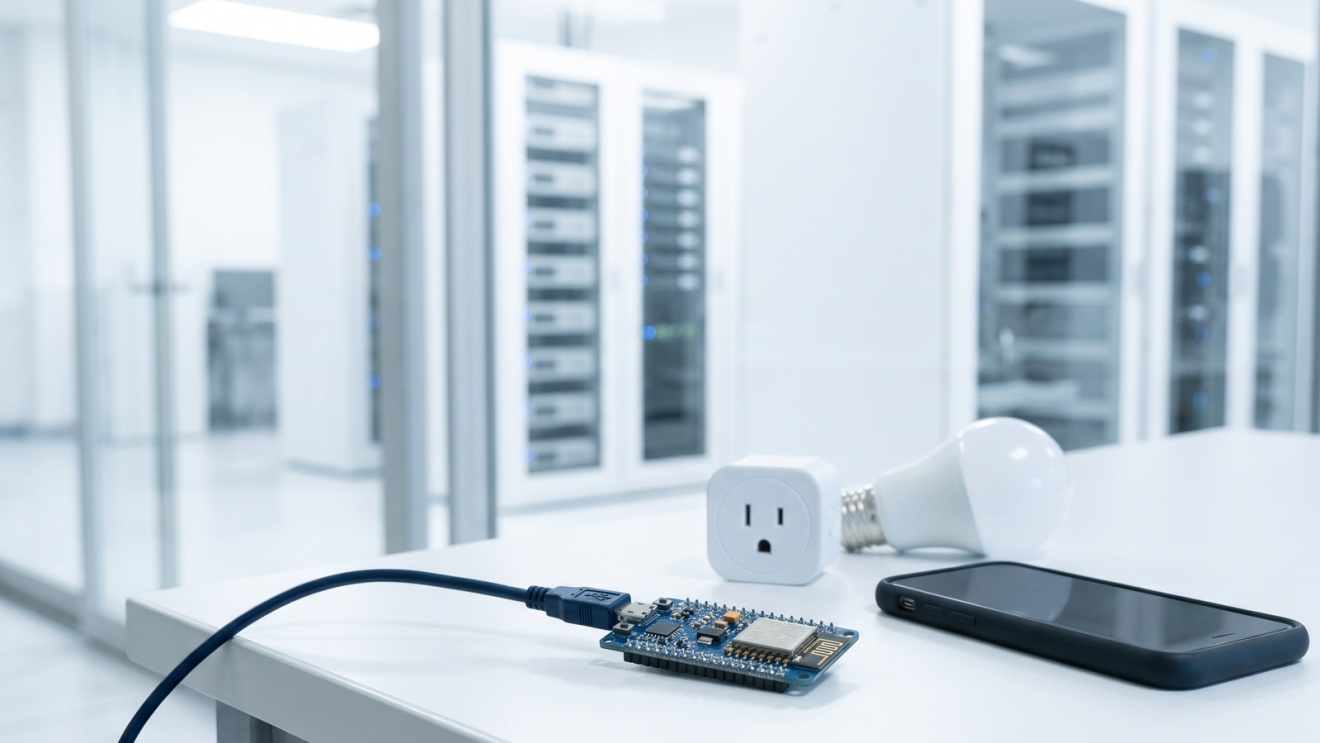
Representative image, AI-generated.
Related articles
- PostgreSQL: The Compelling Choice to Elevate Modern IoT Applications6 September 2023
- What is Matter – The Next Gen Smart Home Standard?27 December 2022
- Nordic: Low Cost USB Dongle for nRF Connect PC Tool18 July 2018
- Qualcomm announces Snapdragon 600E and 410E for embedded computing1 October 2016
- NXP Releases World’s Smallest Integrated Single Chip System for the Internet of Things18 March 2016