
TDK Launches Dual-Output 3D Hall-Effect Switch Family for Motor Speed and Direction Sensing
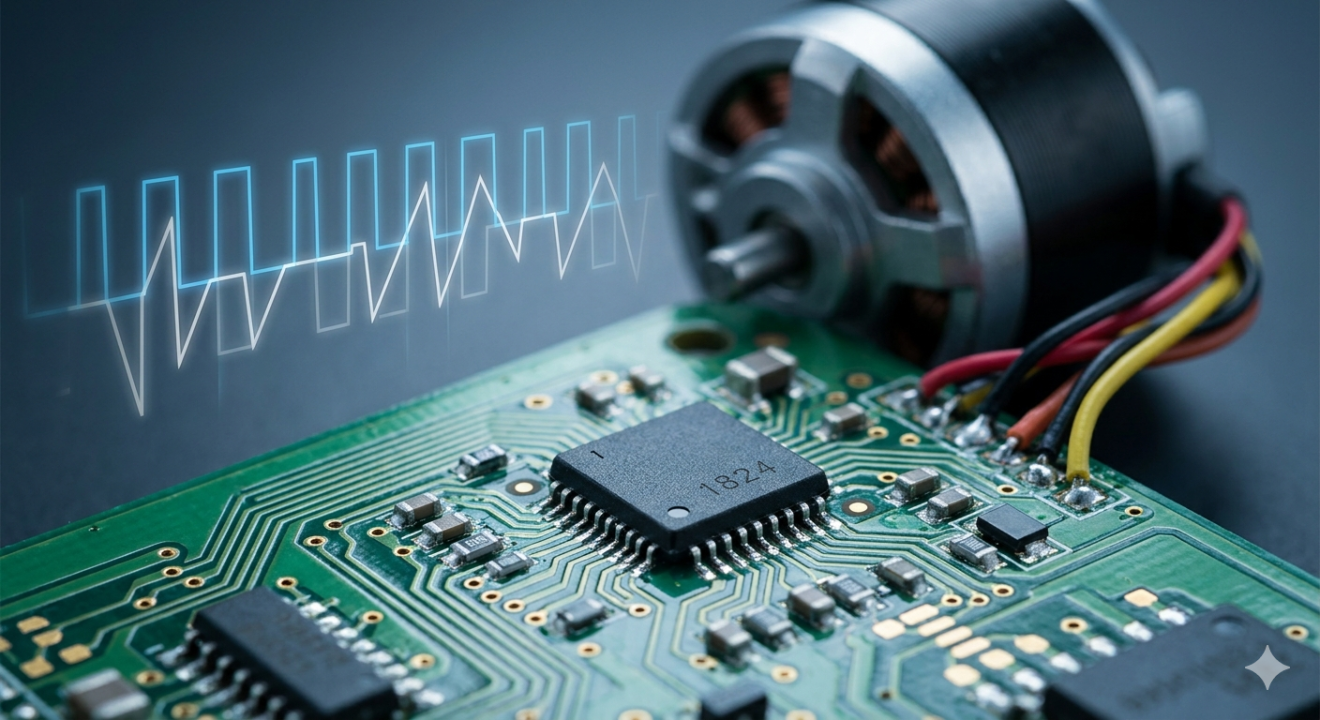
New Micronas sensors deliver simultaneous speed and direction outputs from a single device, targeting automotive and industrial motor control applications
TDK Corporation has launched a new family of dual-output 3D Hall-effect switches under its Micronas sensor brand, designed for precise motor speed and direction sensing in automotive and industrial applications. The announcement, made May 28, 2026, extends TDK-Micronas’ established Hall-switch portfolio with a device capable of delivering two independent switching outputs from a single sensor package.
What the Device Does
Conventional Hall-effect switches provide a single output — typically speed pulse trains derived from a rotating pole wheel or gear tooth target. Detecting rotation direction alongside speed has historically required either two separate sensors or more complex position sensor architectures.
The new dual-output family resolves this by integrating two functional outputs within one package: one output carries the speed signal generated by successive pole transitions, while the second output encodes rotation direction. This allows motor controllers and ECUs to receive both data streams over a simple 3-wire interface without adding board real estate or external signal conditioning.
The use of 3D Hall sensing — measuring magnetic field components across multiple axes — is the enabling technology here. Rather than relying on a single planar Hall plate sensitive only to the perpendicular field component, 3D sensing captures BX, BY, and BZ field vectors. This gives the device the spatial information needed to determine which direction the magnetic target is rotating, not just that it is rotating.
Technical Positioning
TDK-Micronas has built its Hall sensor portfolio around several distinct performance tiers. The new dual-output switch family sits within the switch segment — devices that deliver digital switching outputs rather than analog position data — but brings 3D field measurement capability previously found only in TDK-Micronas’ higher-end position sensor families such as the HAL 37xy and HAL 39xy series.
The family targets gear-tooth or pole-wheel configurations common in brushed DC and BLDC motor assemblies. Key application areas include window lifter and sunroof actuators, HVAC fan motor control, industrial conveyor and pump motor feedback, power tools and appliance motor control, and e-bike and micromobility drivetrains.
The device is expected to be AEC-Q100 qualified for automotive use and will operate across the standard automotive temperature range of −40°C to +170°C junction temperature, consistent with TDK-Micronas’ existing Hall switch families.
Context: Why This Matters
Motor control systems in modern vehicles and industrial equipment increasingly require closed-loop feedback on both speed and direction — not just for performance tuning but for safety and fault detection. A motor driven in the wrong direction during startup or reversal events can cause mechanical damage or trigger safety faults. Detecting direction in real time at the sensor level, rather than inferring it from MCU-side signal phase comparison, reduces latency and simplifies firmware.
For system designers, consolidating speed and direction into a single device also eliminates the mechanical challenge of positioning two Hall sensors at precise angular offsets relative to the same target magnet. This is particularly relevant in compact motor assemblies where PCB space around the motor shaft is constrained.
TDK-Micronas has shipped over 6 billion Hall sensors to the automotive and industrial market to date. The new dual-output family adds a practical, cost-effective option between single-output Hall switches and full angular position sensors for applications that need more than a speed pulse but don’t require continuous angle data.
Availability
Sample availability and production timelines have not been confirmed in initial announcements. Further technical details and ordering information are expected to be published on the TDK-Micronas product pages at micronas.tdk.com.
Related articles
- A $2,000 Desktop AI Box Is Going After Nvidia’s $6,950 DGX Spark — and the TOPS Argument Is the Interesting Part22 October 2026
- Vishay’s Latest RGB LED Brings 70% More Brightness in a 22% Smaller Package17 July 2025
- Anthropic: Connect Claude to Notion, Canva, Linear, and Your Desktop15 July 2025
- Infineon XENSIV 3D Sensors Launched — A Must-Know for Electronics Engineers11 July 2025
- MIT’s New Low-Power 5G Chip10 July 2025