Nordic Semiconductor Brings AI-Assisted Debugging to Deployed IoT Fleets
The move extends AI support beyond the code editor to cover SDK migration, board bring-up, and post-deployment root-cause analysis
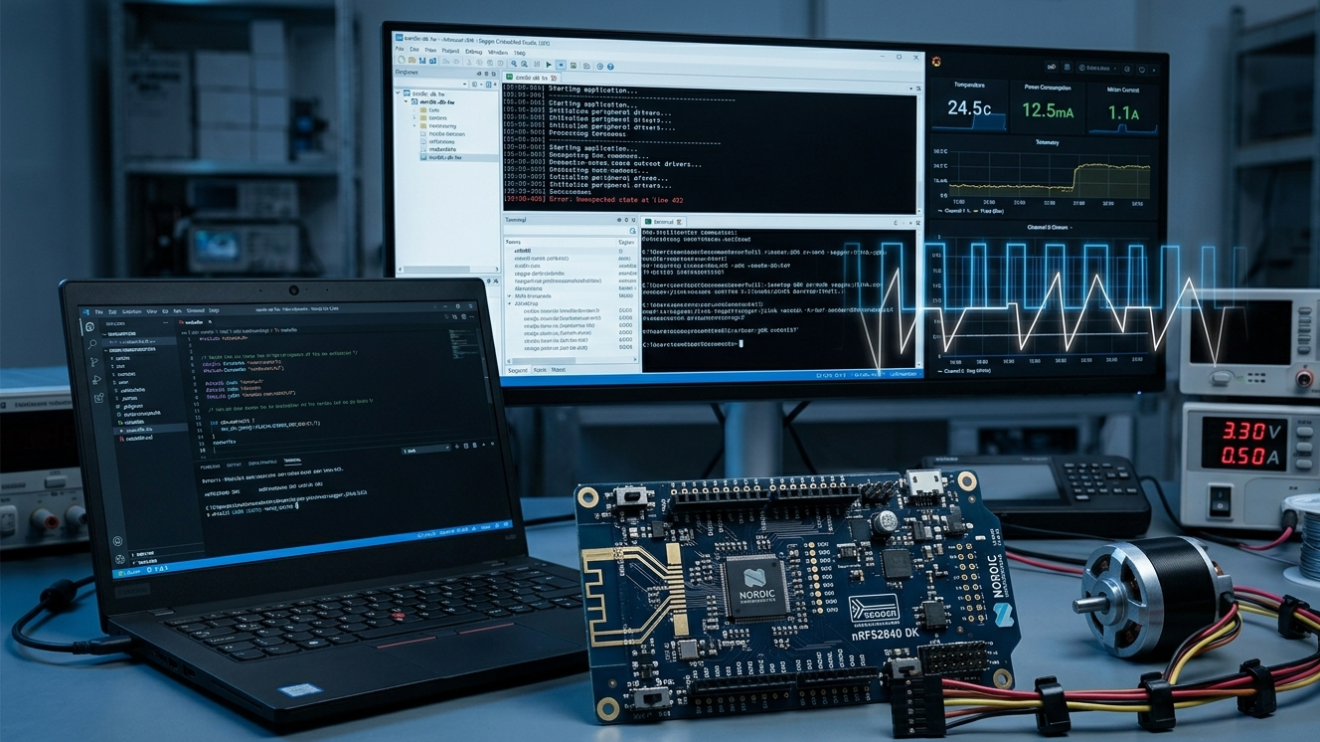
Nordic Semiconductor (Nordic) has launched AI-assisted development capabilities that span the full wireless IoT product lifecycle — from initial prototyping on a development kit through to debugging devices already deployed in the field. The capability is available now and targets developers building on Nordic’s chip-to-cloud platform.
Beyond Code Completion
Most AI tooling aimed at embedded engineers stops at the IDE: code completion, documentation search, and example generation. Nordic’s approach differs in scope. The company is positioning AI assistance as a continuous layer across its hardware, SDK, development tools, and cloud lifecycle services — with the goal of maintaining shared context as a product moves from lab to production to field.
The practical implication is that AI assistance can be applied to tasks that go beyond syntax: SDK version migration, custom board bring-up, production handover, and root-cause analysis of devices already running in the field. Nordic says developers can access this through their preferred AI assistant via Nordic MCP servers, rather than being locked into a single proprietary interface.
Why Fleet-Level Context Matters
The hardest embedded problems are typically contextual, not syntactic. A crash on a deployed device may involve SDK version history, hardware configuration, device logs, and cloud-side lifecycle data simultaneously. Standard AI coding assistants lack that context entirely.
Nordic’s claim is that because its stack covers silicon, SDK, and cloud lifecycle services in an integrated environment, an AI assistant operating within that environment has access to a more complete picture — from how a device was originally built to what it has reported from the field. That continuity is the core architectural bet.
For OEMs, the value is conditional: it scales with how deeply a project uses Nordic’s chip-to-cloud environment. Teams that use Nordic’s SDK for firmware but manage deployed devices through separate operational tools will have less lifecycle context available to the AI. Projects that stay within the Nordic stack from development kit through cloud connectivity stand to benefit most.
Implications for OEMs and System Integrators
For IoT product teams, the immediate impact is potentially less friction between early prototyping and long-term maintenance. Nordic states that AI assistants in this environment can produce more accurate results in fewer iterations — which has a direct effect on token cost and developer time during integration and debugging cycles.
For system integrators and enterprises managing connected product deployments, the more relevant capability is post-deployment debugging with lifecycle context already attached. Field support engineers handling escalations would have access to development-side history without needing to reconstruct it manually.
This announcement also reflects a broader shift in how wireless semiconductor vendors compete. Radio silicon and SDK breadth are no longer sufficient differentiators. Nordic, like others in the space, is now packaging hardware, embedded software, cloud services, and developer experience as an integrated platform — and using AI as the interface layer across that stack.
Nordic has not disclosed performance benchmarks, quantified productivity gains, or deployment scale in this announcement. What it has introduced is an architectural approach: AI assistance tied to lifecycle context rather than treated as a standalone feature. For IoT teams evaluating embedded platforms, that distinction is worth examining carefully.
Nordic’s AI-assisted development capabilities are available now for developers working on the Nordic chip-to-cloud platform.
Related articles
- A $2,000 Desktop AI Box Is Going After Nvidia’s $6,950 DGX Spark — and the TOPS Argument Is the Interesting Part22 October 2026
- Bridging the Skill Gap : Where are the Jobs for India’s Engineers?12 August 2025
- OpenAI’s gpt-oss Models: No Internet Needed6 August 2025
- AI, But Verify: How IIT Delhi is Teaching the Future to Think5 August 2025
- IndiaAI Mission: 570 AI Labs. 1.5 Lakh Students29 July 2025