TI Ships the First Commercial CAN XL Transceiver, Taking the Bus to 20 Mbps
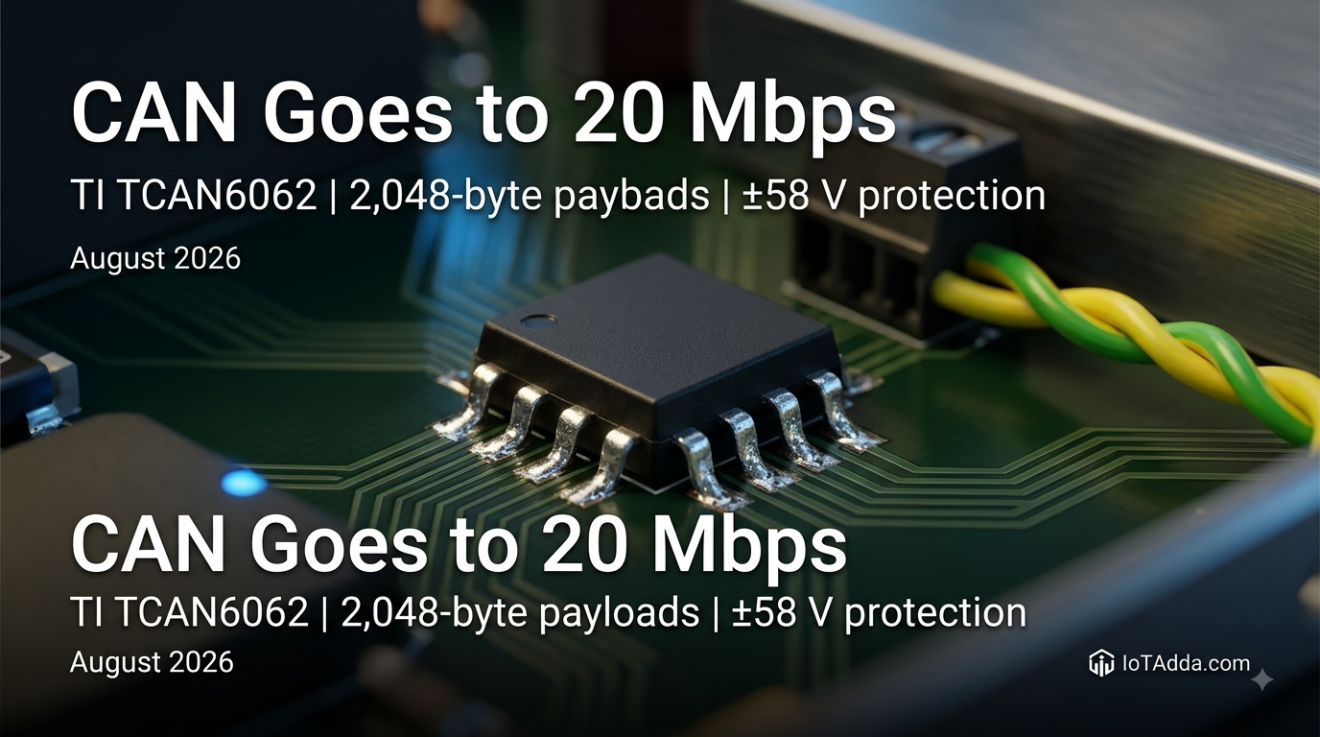
The TCAN6062 carries 2,048-byte payloads at up to 20 Mbps with ±58 V bus protection — and is designed to drop into an existing CAN FD design rather than force a redesign.
Texas Instruments has begun shipping the TCAN6062, described as the first commercial CAN XL transceiver, supporting signalling rates up to 20 Mbps and frame payloads up to 2,048 bytes. It lands as the third generation of the CAN bus moves from specification into silicon that engineers can actually buy.
For a protocol that has carried industrial and automotive control traffic since the late 1980s on 8-byte frames, that is a substantial change in what the wire can carry.
What CAN XL changes
CAN’s constraint was never reliability — it was bandwidth and payload size. Classical CAN moved 8 bytes per frame at 1 Mbit/s. CAN FD, introduced to relieve that, raised the payload to 64 bytes and the data-phase rate to around 8 Mbit/s. CAN XL takes the payload to 2,048 bytes and the rate to 20 Mbit/s.
| Max payload | Data-phase rate | |
| Classical CAN | 8 bytes | 1 Mbit/s |
| CAN FD | 64 bytes | up to 8 Mbit/s |
| CAN XL | 2,048 bytes | up to 20 Mbit/s |
The jump past 1,500 bytes is the interesting one. It clears a standard Ethernet frame, which means CAN XL can tunnel TCP/IP traffic directly — carrying diagnostics, sensor streams, control traffic and over-the-air update payloads over the same physical layer that already runs the machine. For system designers, that opens the possibility of collapsing a separate Ethernet run rather than adding one.
The silicon
TI’s part supports classical CAN, CAN FD, CAN FD SIC and CAN XL on the same device — the compatibility story is central to how it is positioned. TI describes the design as enabling incremental migration, letting teams evolve existing designs without a full redesign.
| Parameter | TCAN6062 |
| Supply voltage | 4.75 V to 5.25 V |
| I/O supply | 1.8 V / 3.3 V / 5 V |
| Signalling rate | Up to 20 Mbps (FAST mode); up to 8 Mbps (SIC mode) |
| Bus fault protection | −58 V to +58 V |
| Protocols | CAN, CAN FD, CAN FD SIC, CAN XL |
| Packages | SOIC-8 (4.9 × 6 mm); VSON-8 (3 × 3 mm) |
| Protection | IEC ESD on bus pins, undervoltage detection, thermal shutdown, TXD dominant timeout |
The signal improvement capability (SIC) is worth noting for anyone who has fought a marginal bus. SIC actively damps the ringing that appears at the dominant-to-recessive edge — the artefact that limits how many nodes and how much stub length a fast CAN network tolerates. TI cites a reduction in ringing of up to 80%, which in practice is what makes higher rates survivable on real topologies rather than only on a bench.
Where TI is aiming it
The stated targets are humanoid robots, industrial robots and human-machine interface systems — applications where a growing number of joints, sensors and actuators have been straining against CAN FD’s payload ceiling, and where running Ethernet to every node is expensive in cost, weight and connector count.
What this means for machine builders here
The instinct in Indian industrial design has been to treat CAN as legacy and Ethernet as the future — reach for Modbus TCP or EtherCAT the moment a project needs real bandwidth. CAN XL complicates that reflex in a useful way.
A retrofit on an existing machine is where this shows up first. The twisted pair is already run, the connectors are already there, the electrical environment is already proven, and the maintenance team already knows how to fault-find it. If a 2,048-byte payload at 20 Mbps is enough for what you are adding — condition-monitoring streams, a vision-assisted pick head, firmware pushed over the air to thirty nodes — then CAN XL lets you keep the physical layer and change only the endpoints. That is a materially cheaper upgrade path than pulling new cable through a working plant, and cable pulling is usually where retrofit budgets actually go.
The caveat is that a transceiver is only one half. CAN XL also needs controller support in the MCU, and the availability of XL-capable controllers — not transceivers — will set the real pace of adoption over the next couple of years.
Sources
- Electronics Weekly — CAN XL transceiver supports data rates up to 20Mbps (2026-08-13) https://www.electronicsweekly.com/news/products/can-xl-transceiver-supports-data-rates-up-to-20mbps-2026-08/
- Texas Instruments — TCAN6062 product page and datasheet (datasheet dated 2026-06-30) https://www.ti.com/product/TCAN6062
Related articles
- Automotive Industry – Software-Defined Vehicles to Generate $755B by 202925 July 2025
- The Silent Shift: Why Every Indian Car Now Runs on Sensors and Code11 June 2025
- Snowflake’s Automotive Play: Rewiring the Industry with Data, IoT, and AI27 May 2025
- Ashok Leyland’s AI and IoT-Powered Trucks Are Driving the Future of Smart Fleets in India26 May 2025
- India’s Auto Future is Smart, Safe, and Autonomous by 2030: NITI Aayog23 May 2025