A 16GB Raspberry Pi 5 Now Costs $385. Here’s What Indian Labs and Makers Should Buy Instead
Key takeaways
- Raspberry Pi raised the 16GB Raspberry Pi 5 by $80 to $385 (about ₹36,100) on 2 November 2026, more than three times its $120 launch price.
- Raspberry Pi 5 list prices now run $45 (1GB), $77.50 (2GB), $110 (4GB) and $175 (8GB); only the 1GB board has not risen since December 2025.
- Raspberry Pi says the LPDDR4 memory on Pi 4 and Pi 5 rose seven-fold in price over a year; this is the fifth Pi 5 price round since December 2025.
On 2 November, Raspberry Pi raised the price of the 16GB Raspberry Pi 5 by $80, to $385. At ₹93.70 to the dollar that is about ₹36,100, before customs duty and GST. The same board launched at $120 in January 2025. The 16GB Compute Module 5 variants went up by $40, while the 16GB Raspberry Pi 500+ keyboard computer was held at its existing price.
Eben Upton’s post blames “a lack of alternative supply for 16GB DRAM”, compounded by other component shortages. I train engineers and build embedded products, and I field the same question every week now: should we buy before it goes up again? My answer for most Indian labs and makers is different. Buy less memory.
Five price rounds in eleven months
This is not a one-off. Raspberry Pi has repriced the Pi 5 in December 2025, February 2026, April 2026, October 2026 and now November. In April the company said the LPDDR4 DRAM used on Pi 4 and Pi 5 had risen seven-fold in price over the previous year, as memory makers chase AI infrastructure demand. Here is where the range stands, from Raspberry Pi’s November 2026 product brief.
| Raspberry Pi 5 | Price before Dec 2025 | List price now (USD) | Approx. INR | Who it suits |
|---|---|---|---|---|
| 1GB | launched Dec 2025 at $45 | $45 | ₹4,200 | Headless gateways, single-purpose nodes, Lite OS |
| 2GB | $50 | $77.50 | ₹7,300 | Linux and Python labs, MQTT gateways, GPIO work |
| 4GB | $60 | $110 | ₹10,300 | Desktop teaching labs, camera and OpenCV projects |
| 8GB | $80 | $175 | ₹16,400 | Several containers at once, heavier vision work |
| 16GB | $120 | $385 | ₹36,100 | Rarely justified for a lab at this price |
INR at ₹93.70/$ (PTI, 11 November 2026). Indian street price will differ (duty, GST).
Buy the memory the workload needs
Raspberry Pi itself now tells customers not to pay for headroom they don’t need. I agree, and the arithmetic is sharp. The gap between a 4GB and an 8GB board is $65, about ₹6,100. Across ten lab seats that is roughly ₹61,000 before tax, which is a lot of sensors, displays and spare SD cards.
- Teaching Linux, Python, GPIO and networking: 2GB on Raspberry Pi OS Lite is enough. Run headless and SSH in; the browser is usually what eats the memory.
- An IoT gateway with Mosquitto and Node-RED: 2GB to 4GB. I have yet to see a classroom gateway that needs more.
- A desktop lab where students use a browser, an IDE and a camera: 4GB.
- Several containers (a broker, a time-series database and a dashboard) or vision work with a desktop open: this is where 8GB earns its price.
When a Pi is the wrong tool
For a first course in embedded systems, I would rather hand a student an ESP32-class microcontroller board than any Pi. It teaches interrupts, timers, an RTOS and power budgets, which are the skills industry actually hires for. Its working memory is on-chip SRAM measured in kilobytes, so it is far less exposed to the LPDDR4 squeeze.
Raspberry Pi also points buyers to older models. The Pi 3B, 3B+, 3A+ and Zero 2 W use LPDDR2 memory, of which the company says it holds substantial inventory, and it does not expect to raise their prices. For GPIO and sensor labs, they are still perfectly good teaching boards.
If the real goal is running local language models, a $385 Pi is the wrong comparison. Price an x86 mini PC or a shared lab workstation first; many mini PCs take SO-DIMM memory that can be added later, which a Pi cannot. Get fresh quotes, though: alternatives are not immune. CNX Software reports that NVIDIA raised Jetson module and devkit prices by up to 101% in July.
Buy from approved resellers
Raspberry Pi warns that some sellers are using the shortage to charge inflated prices or ship products that are not what they seem. Its Approved Resellers abide by the official published maximum prices. Before raising a purchase order, check the Approved Reseller page on raspberrypi.com for India and ask for a GST invoice.
Why it matters for India
Most Indian college lab budgets are sanctioned in rupees a year ahead, while the Pi 5’s dollar price has changed five times in eleven months; a quote approved last semester will not buy the same lab today.
Departments should specify memory by workload in the purchase order, not ‘latest, highest variant’, and ask resellers for quotes with a fixed validity period.
The cheapest skills to teach right now, microcontrollers, RTOS and low-power design, are also, in my experience, the ones Indian product teams find hardest to hire for.
Our view
Don’t panic-buy, and don’t wait for prices to fall. CNX Software notes that Micron expects the memory shortage to last at least until 2028, so plan for today’s prices. Raspberry Pi says it will reverse the increases when memory gets cheaper, and I take it at its word, but a lab cannot plan around a promise with no date. Right-size every board: 2GB or 4GB for most teaching, 8GB only when you can name the workload that needs it, an ESP32-class board for first embedded courses, and a proper workstation for LLM experiments. The 16GB Pi 5 is a fine computer. At $385, it is simply not the right buy for an Indian lab.
Related reading
- IoT Platforms and Development Boards
- Arm University Program launches Embedded Linux Education Kit
- Exploring the dsPIC33CK64MC105 Curiosity Nano Evaluation Kit
- ASRock Launches AI-Optimized Industrial Motherboards with Intel Core 200S for Smart Edge Computing
Sources
- Raspberry Pi (Eben Upton): Price rises for some 16GB Raspberry Pi products, 2026-11-02
- Raspberry Pi: Raspberry Pi 5 product brief (list prices, published November 2026), 2026-11-02
- Raspberry Pi: Price increases for 2GB Raspberry Pi 4 and Raspberry Pi 5, 2026-10-01
- Raspberry Pi: A new 3GB Raspberry Pi 4 for $83.75, and more memory-driven price increases, 2026-04-01
- Raspberry Pi: More memory-driven price rises, 2026-02-02
- Raspberry Pi: 1GB Raspberry Pi 5 now available at $45, and memory-driven price rises, 2025-12-01
- CNX Software (Jean-Luc Aufranc): When will this stop? The Raspberry Pi 5 16GB SBC now sells for $385, 2026-11-03
- Telangana Today (PTI): Rupee rises to 93.70 against US dollar as domestic markets strengthen, 2026-11-11
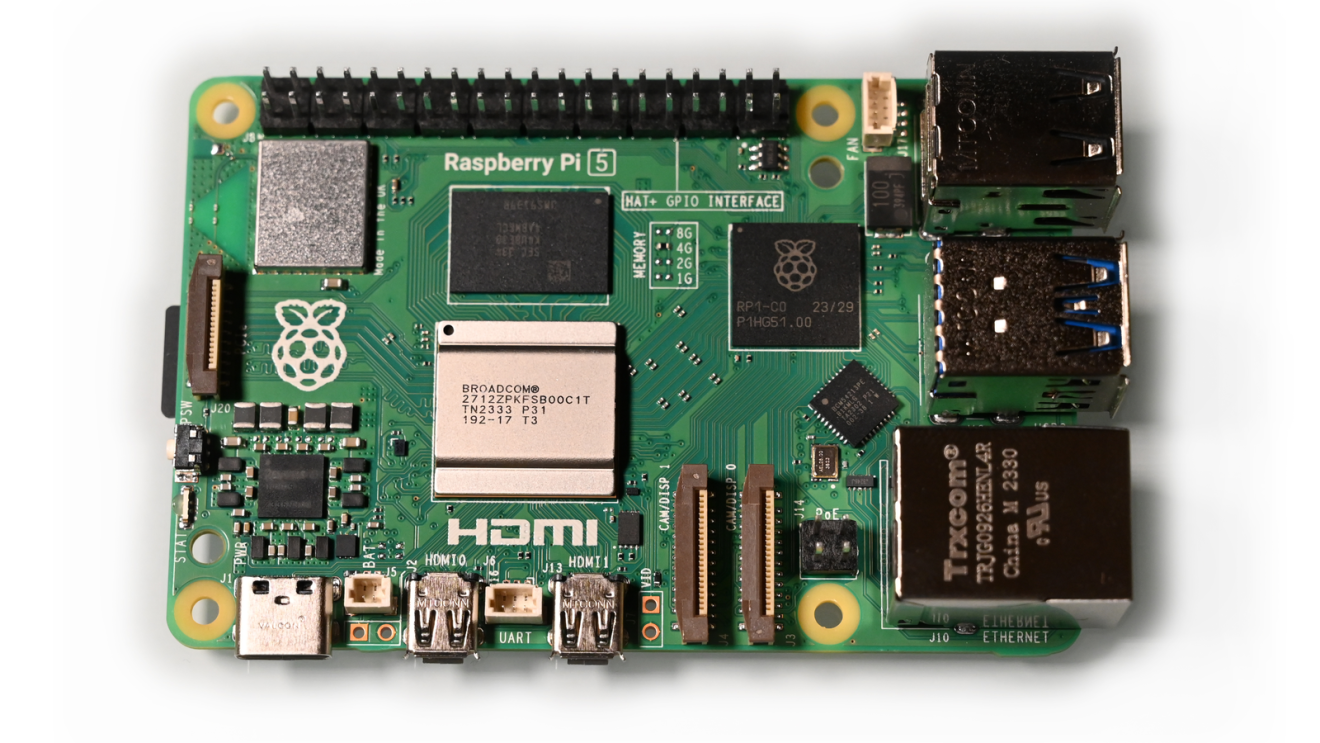
Raspberry Pi 5. The black chip above the Broadcom processor is the LPDDR4X memory whose cost now sets the board’s price. Photo: SimonWaldherr / Wikimedia Commons (cropped) (CC BY 4.0).
Related articles
- Toshiba and Nordic Semi team-up to launch the World’s Smallest BLE Module14 May 2021
- Mini Bluetooth Smart module10 November 2015
- Benefits of connected cars with IoT and ADAS12 June 2023
- Securing the Industrial Internet of Things: Challenges and Solutions9 June 2023
- The Future of Smart Mobility: V2V, V2I, and V2G Communications7 June 2023